
Discover expert articles on AI, SaaS, software, marketing, SEO, affiliate marketing and startup growth.
Discover expert articles on AI, SaaS, software, marketing, SEO, affiliate marketing and startup growth.
By LoyAnn Sherwood
Published on Jul 28, 2026
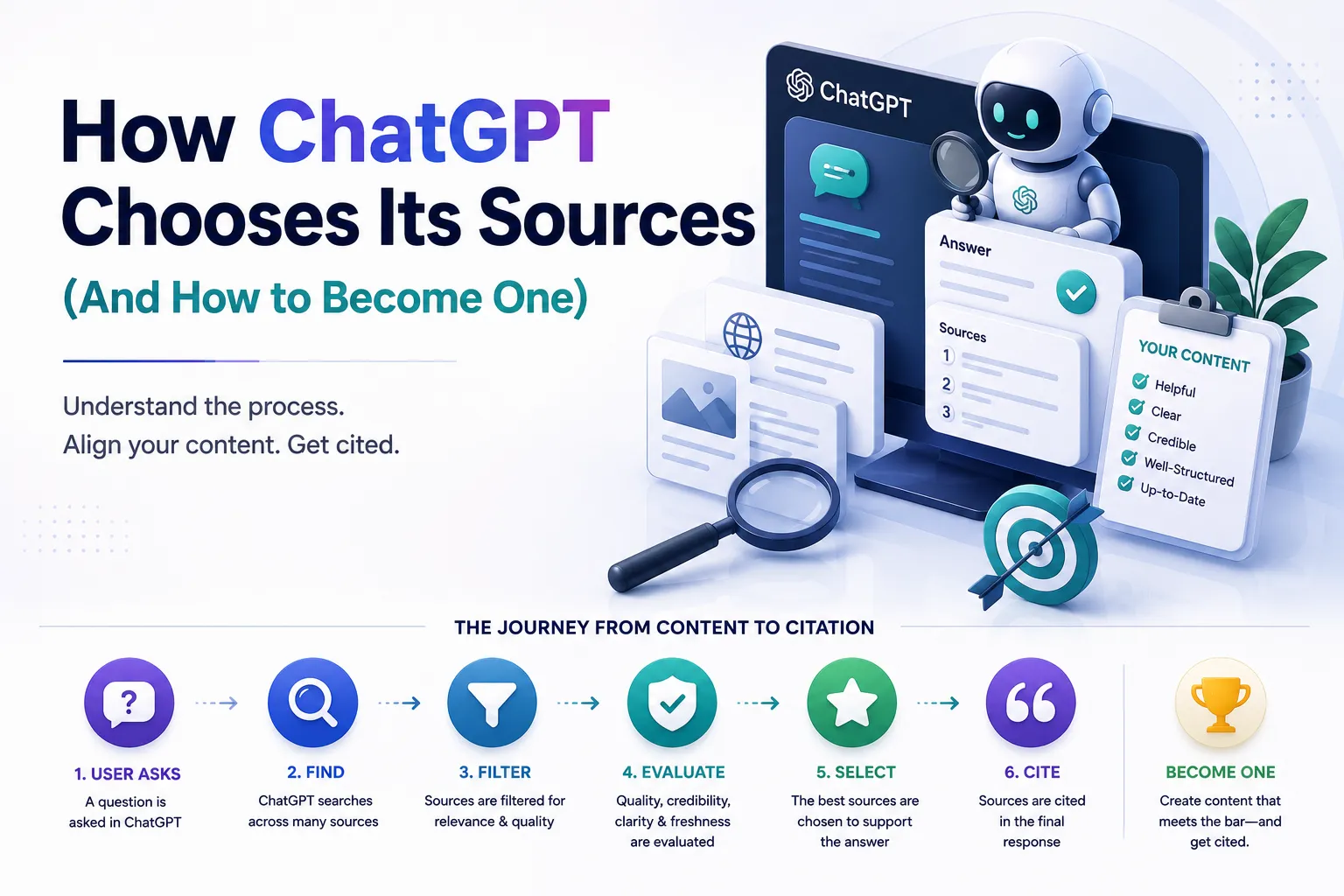
ChatGPT chooses its sources by combining what it learned in training with live web searches when a question needs current information. In live-browsing mode it runs several searches, then evaluates candidate pages for relevance, credibility, structure, and freshness — and cites the pages that most clearly and trustworthily answer the exact question. To become one of those sources, make your page the most complete, credible, and current answer to a specific question.
Ask ChatGPT a question today and there's a good chance it won't just answer — it will point to where the answer came from. A small citation, a linked source, a name you recognize or don't. For anyone who runs a website, writes content, or markets a business in the United States, that little citation has become a big deal. It's a new kind of visibility, one that doesn't ask you to rank first on a results page, but asks something arguably harder: to be trusted enough that an AI model chooses to speak on your behalf.
That shift raises an obvious question. How does ChatGPT actually decide which sources to use? Is it picking the biggest brand, the newest article, the highest-ranking Google page, or something else entirely? And more importantly, once you understand the mechanism, what can you realistically do to become one of the sources it reaches for?
This guide walks through both halves of that question in plain language — how ChatGPT's source selection actually works under the hood, and the specific, practical steps that give your content a genuine shot at being the answer ChatGPT reaches for next.
A few years ago, being cited by an AI chatbot wasn't something most businesses thought about. Now it's a daily reality for millions of Americans who ask ChatGPT for product comparisons, health information, local recommendations, and how-to guidance instead of typing a query into a search bar. Every one of those conversations is a moment where a brand either shows up or doesn't.
Unlike a search results page, ChatGPT doesn't hand the reader ten blue links to sort through themselves. It picks, condenses, and presents. That means the businesses it chooses to cite get an outsized share of trust and attention, while everyone else becomes invisible in that conversation — even if they'd have ranked on page one of a traditional search a year ago.
Understanding the mechanics behind that selection isn't a technical curiosity anymore. It's becoming as fundamental to digital marketing as understanding how a search engine crawls and indexes a page once was.
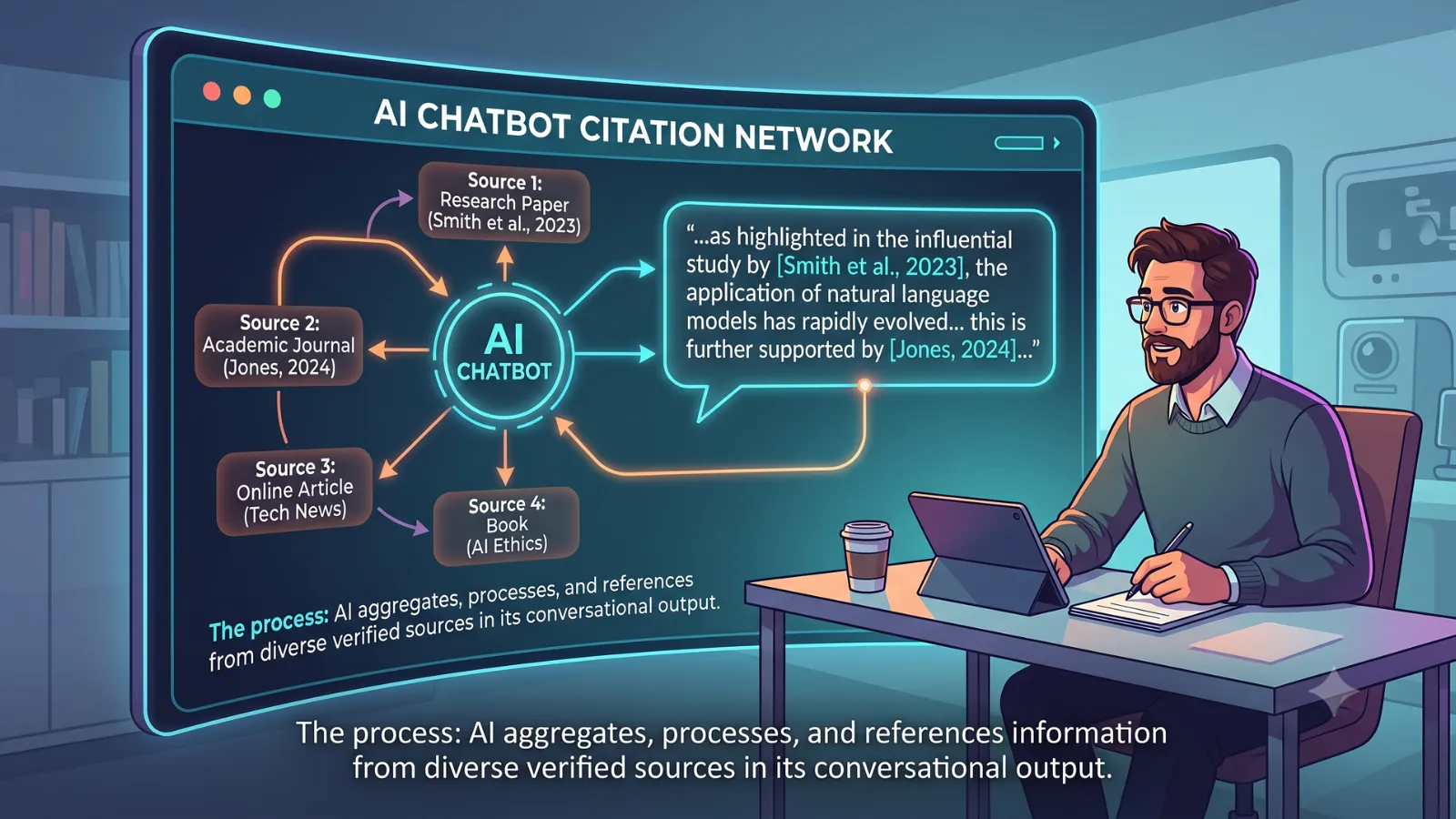
The most important thing to understand about ChatGPT's sourcing is that it doesn't work the same way for every single response. There are two distinct modes at play, and knowing the difference changes how you think about optimization entirely.
The first is what's often called parametric memory. This is ChatGPT answering purely from patterns it learned during training, without reaching out to the live internet at all. There's no citation here because there's no retrieval happening — the model is drawing on the enormous archive of text it was trained on, which has a fixed cutoff point and doesn't reflect anything that happened afterward.
The second is live browsing, sometimes described as retrieval. This kicks in when a question needs current information, specific numbers, recent news, or when the person explicitly asks for sources. In this mode, ChatGPT actually reaches out, pulls in real web pages, and cites what it used. This is the mode content creators can actually influence — and it's the one that matters for anyone trying to be cited.
The practical takeaway is simple: not every query is winnable. If a topic doesn't naturally trigger a live search, no amount of on-page optimization will get you cited in that particular exchange, because ChatGPT never left its training data to look for you. Your job is to make sure that when browsing does trigger, your page is the one worth fetching.
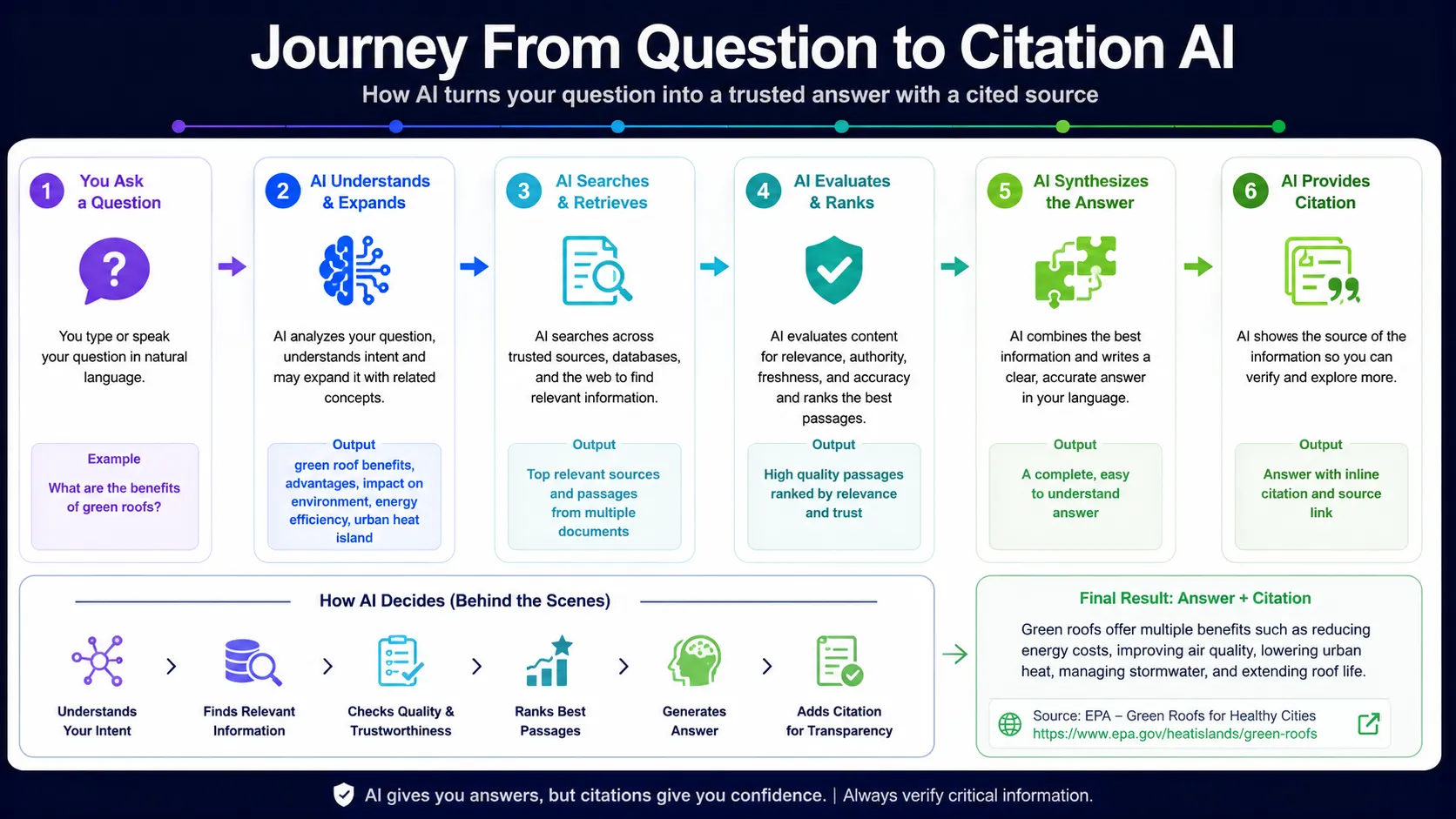
When browsing mode does activate, ChatGPT doesn't just type your question into a search box and grab the first result. It runs through a sequence of steps that looks more like a research process than a simple lookup.
It starts by rewriting the question. A casual, conversational prompt like “what's the best way to save for retirement in my 30s” gets translated internally into more specific, search-friendly phrasing — closer to how a person might type into a search engine than how they'd ask a friend. Pages that clearly answer a specific, well-defined question tend to match these rewritten queries more cleanly than pages written in vague, marketing-heavy language.
From there, it typically runs several related searches rather than just one, pulling from a search index behind the scenes. It then reviews a batch of candidate pages, evaluating them against a mix of relevance and trust signals before narrowing the pool down. Only a fraction of the pages it looks at actually make it into the final response — being fetched is not the same as being cited, and plenty of pages get pulled in during research but never referenced in the answer itself.
Finally, it extracts the specific facts, figures, or explanations it needs and weaves them into a synthesized answer, attaching a citation back to where that information came from. The whole process happens in seconds, but it mirrors what a careful human researcher would do: search broadly, skim critically, and only quote the sources worth quoting.
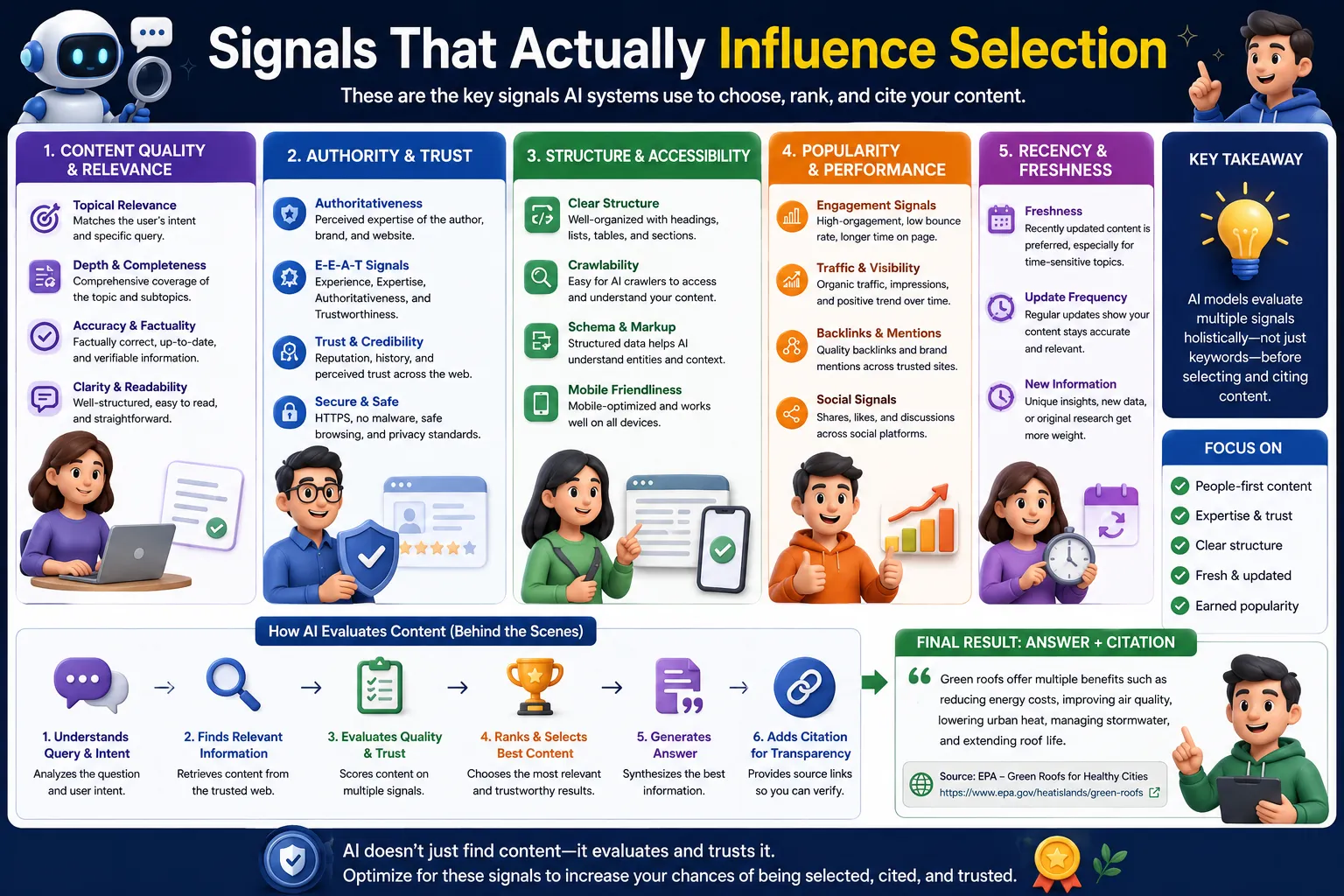
So what separates the pages that get cited from the ones that get skimmed and discarded? Based on how these systems are documented to behave and how they're built on top of standard web search infrastructure, a handful of signals consistently show up as decisive.
Credibility deserves special attention because it isn't just about who you are — it's about how clearly you demonstrate it on the page itself. Author names without context don't carry much weight. Author names attached to real credentials, a visible history of expertise, and a transparent explanation of how a conclusion was reached carry a great deal more. This lines up closely with the same experience, expertise, authoritativeness, and trust principles that have shaped traditional search quality for years — the label may be new, but the underlying idea of proving you know what you're talking about is not.
Recency plays a bigger role than many people expect. For questions where the world could have changed — pricing, regulations, product releases, statistics — the model leans toward content that's demonstrably current. It's not unusual for these systems to add words like “latest” or “current” to their internal search queries automatically, which quietly filters out pages that haven't been touched in a long time, even if the underlying advice hasn't actually changed.
| Signal ChatGPT Evaluate | Why It Matters | How To Strengthen It |
|---|---|---|
| Content depth & expertise | Shows the page fully answers the question | Cover sub-questions, edge cases, and real detail |
| Site & author credibility | Signals the information came from someone qualified | Add author bios, credentials, and an About page |
| Structure & formatting | Makes it easy to lift a clean answer out | Use clear H2/H3s, short paragraphs, lists, and tables |
| Freshness & recency | Time-sensitive queries favor recently updated pages | Refresh key pages, update dates, remove stale info |
| Independent mentions | Other sites talking about you is a trust signal | Earn coverage, guest posts, and citations elsewhere |
| Crawler accessibility | If the page can't be fetched, it can't be cited | Allow AI crawlers, keep pages fast, avoid blocks |
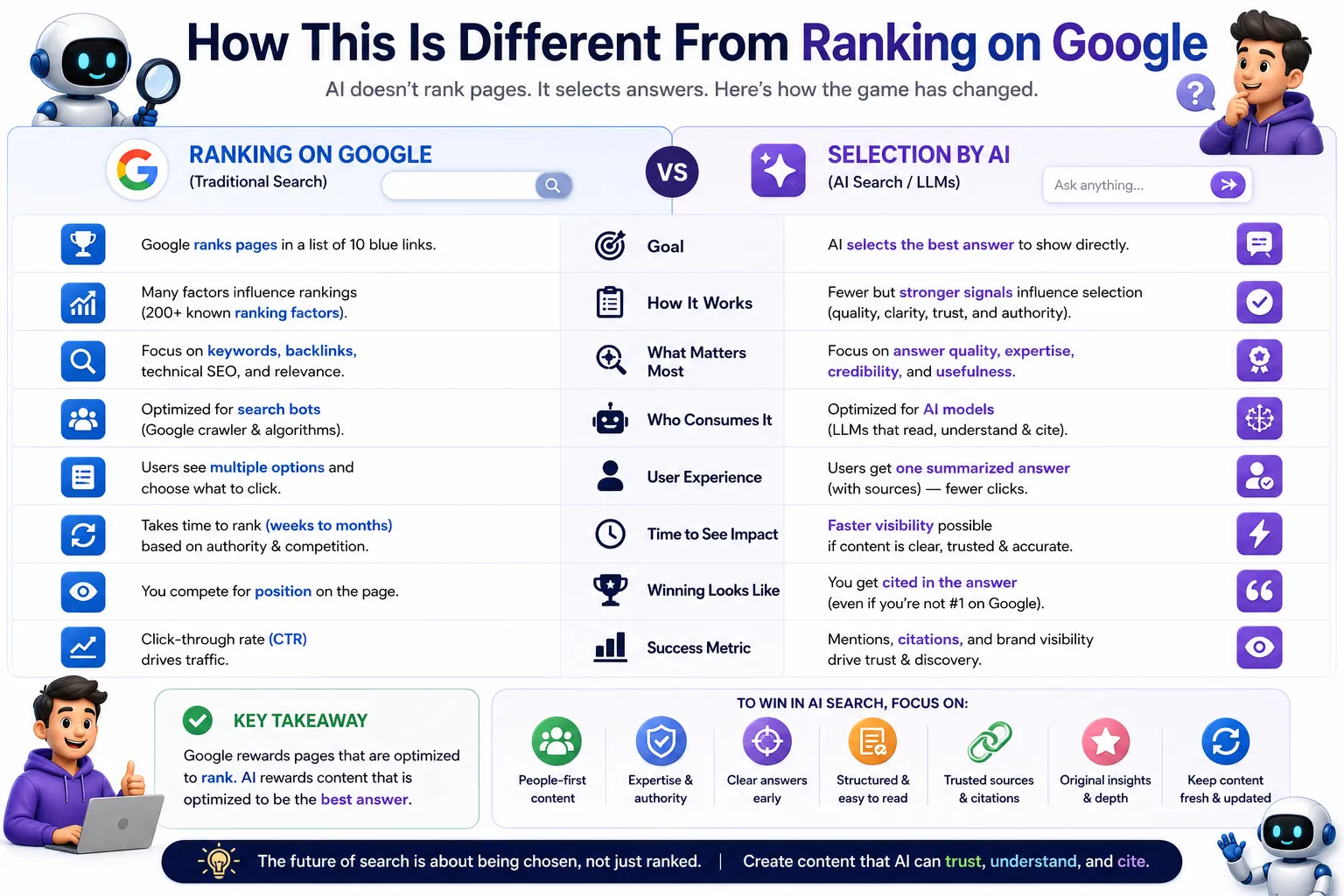
It's tempting to treat this as just another flavor of search engine optimization, but the mental model needs to shift. Traditional SEO is fundamentally about ranking — competing for a numbered position against hundreds of other pages, where being third instead of fifth still delivers meaningful traffic.
AI source selection doesn't work in positions. ChatGPT isn't handing back a ranked list; it's choosing a small handful of sources to actually use, and everyone else, regardless of where they'd rank in a search engine, simply doesn't get mentioned. There's no traffic for being a strong number six here. Either your content earns a place in the synthesized answer, or it contributes nothing to that particular conversation.
That reframes the goal. Instead of asking “how do I outrank the page above me,” the more useful question becomes “how do I become unmistakably the most complete, credible, and current answer to this exact question.” It's a smaller, more selective bar, but it's also a fairer one — depth and honesty tend to matter more here than backlink volume alone.
One detail worth knowing: ChatGPT's browsing capability has historically leaned on Bing's search infrastructure behind the scenes. That means visibility inside Bing Webmaster Tools and confirming your pages are properly indexed there is a practical, often-overlooked step that supports AI citation eligibility, separate from anything you do for Google.
Get first access to exclusive software reviews, hand-picked SaaS lifetime deals, and digital growth strategies delivered straight to your inbox. No spam, ever—just pure software value to scale your business.
57 subscribers have joined!
If you love lifetime SaaS deals as much as I do, then please subscribe to our monthly/weekly AppLuxe newsletter.
Marcus Vance, SaaS Specialist
Once the mechanics make sense, the optimization work itself becomes much more concrete. None of this requires gaming an algorithm — it requires making your expertise genuinely easy for a machine to find, verify, and quote accurately.
A quick note on that priority column: the low-effort, high-leverage items are worth tackling first. Structural fixes like schema markup, FAQ sections, and a content refresh calendar can usually be done in-house within weeks, while original research and earned mentions take longer but tend to pay off the most once they land.
| Optimization Tactic | Impact | Effort | Priority |
|---|---|---|---|
| Rewrite thin pages into comprehensive answers | High | Medium | Do first |
| Add FAQ and Article schema markup | High | Low | Do first |
| Publish original data, surveys, or case studies | High | High | Plan for it |
| Keep cornerstone pages updated on a set schedule | High | Low | Do first |
| Build mentions on trusted industry sites | High | High | Plan for it |
| Allow AI crawlers and verify in Bing Webmaster Tools | Medium | Low | Do first |
Picture two competing pages about the same topic, say, a guide to setting up SMS marketing for a small business. One page is 400 words, written to satisfy a keyword, with no author name and no update date. The other runs 1,800 words, is written by someone with a named marketing background, includes a comparison table, an FAQ section, and was refreshed within the last month to reflect current carrier compliance rules.
When ChatGPT researches that topic, both pages might get fetched. Only one of them is likely to survive into the final cited answer. It's the page that reduces the model's uncertainty the most, the one where the model doesn't have to guess whether the information is current or trustworthy. That's the entire game in one example: reduce uncertainty, and you become citable. Businesses figuring this out for the first time can see a related breakdown of SMS marketing metrics worth tracking for a sense of how depth and specificity make a topic page far more defensible.
Content quality gets you most of the way there, but the technical layer still matters. Structured data markup, particularly FAQ and Article schema, gives AI systems a clean, machine-readable version of your content to lean on instead of having to parse a page visually the way a human would.
The same logic that makes a page rank well and load quickly for a human visitor tends to make it easier for an AI system to access and interpret. Fast-loading pages, clean mobile layouts, and logical internal linking aren't just user-experience niceties anymore, they're part of what keeps your content eligible to be considered at all. If you're weighing platform or template choices for a site rebuild, it's worth reading through a practical comparison like this Elementor Pro review to see how page-builder decisions ripple into both speed and structure.
It's also worth remembering that AI-driven discovery and traditional search aren't separate universes anymore. The same fundamentals — depth, credibility, freshness, and clear structure — increasingly influence both AI Overviews and everyday organic rankings. Businesses that treat this as one unified content discipline, rather than two competing checklists, tend to see the strongest results across both.
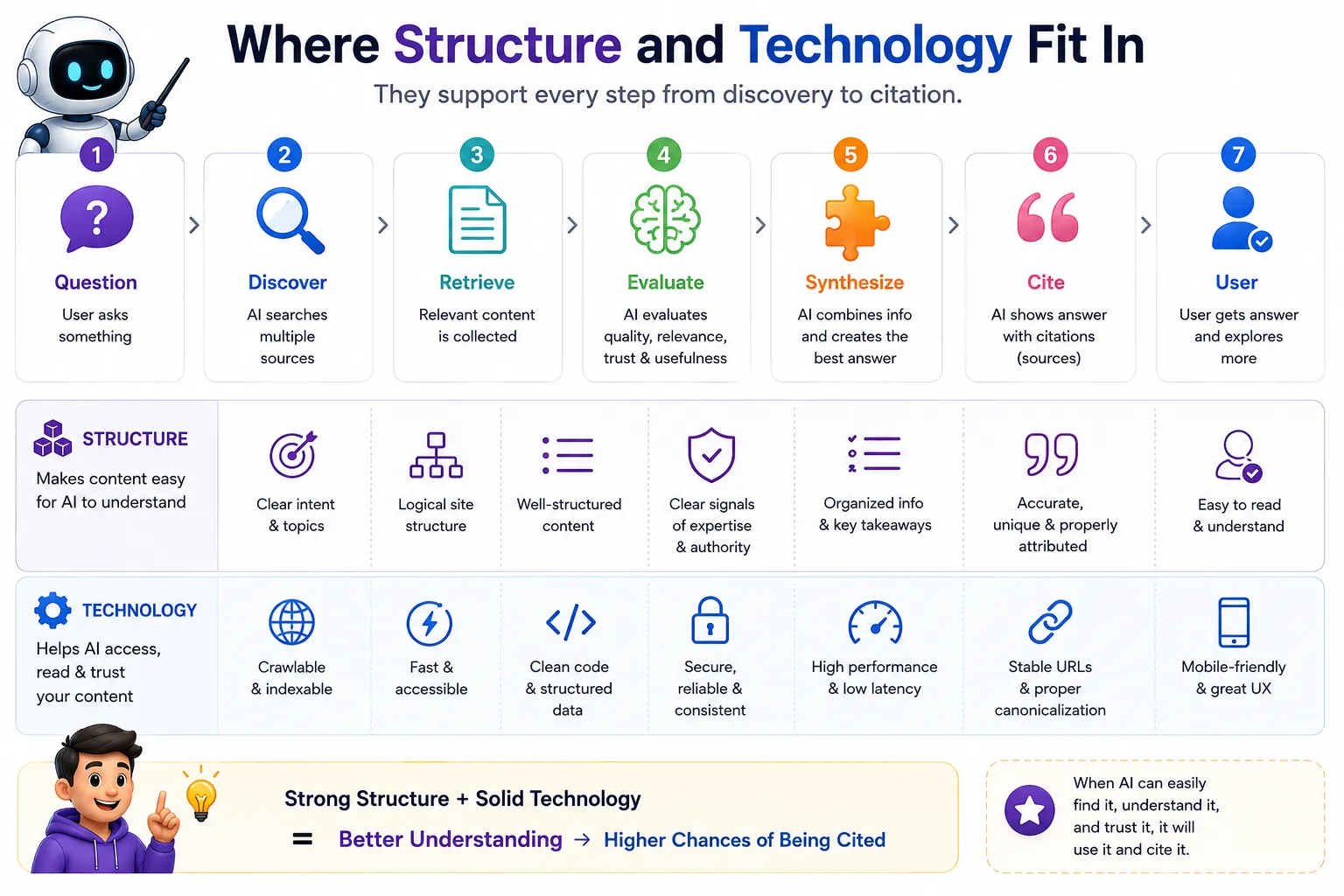
Fixing the first two almost always fixes everything downstream. A page that genuinely answers a real question, backed by real evidence, tends to naturally pick up the structural and freshness signals along the way.
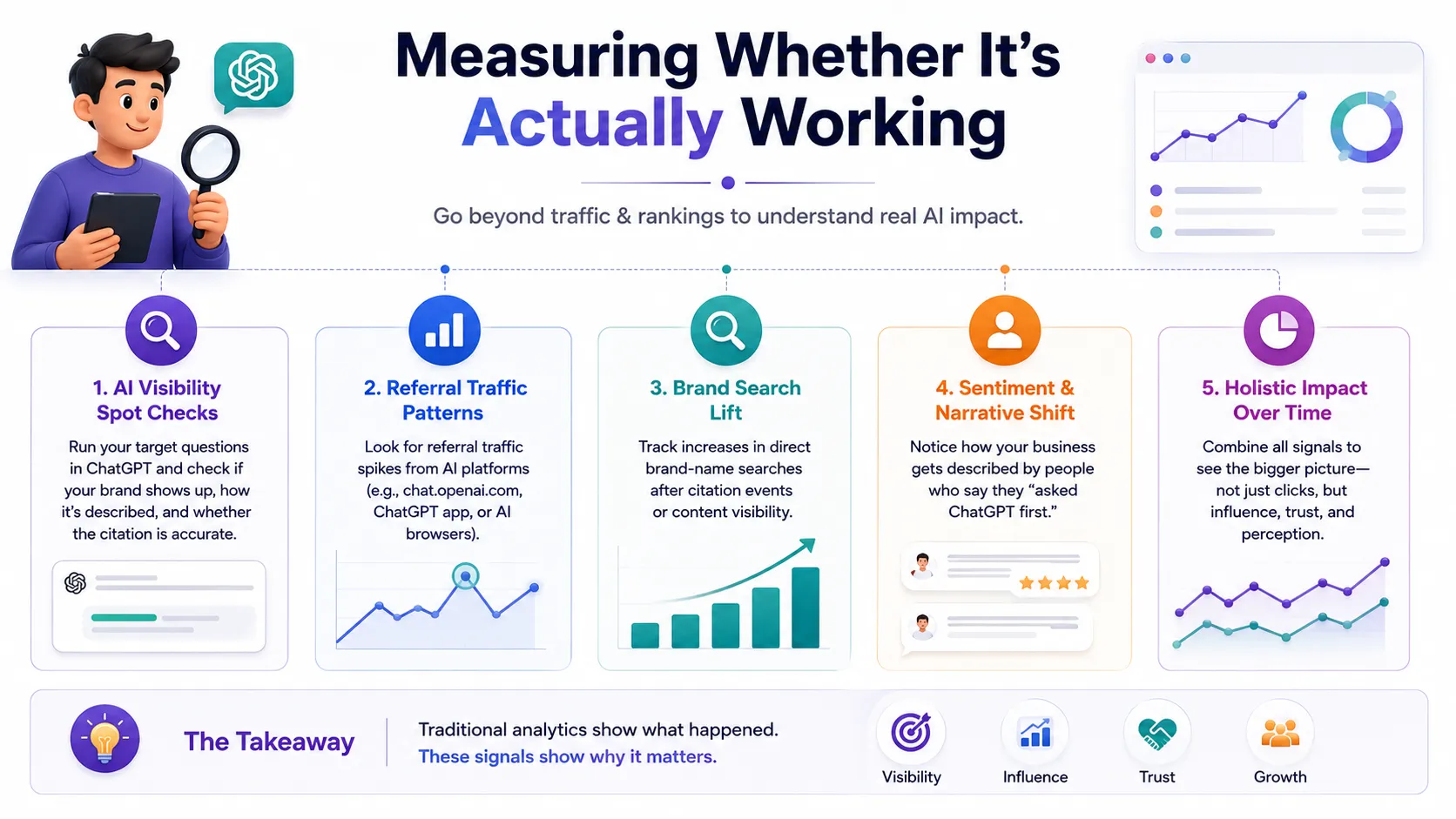
Traffic and rankings alone won't tell the full story anymore, since a citation inside ChatGPT doesn't always translate into a click the way a blue search link does. It's worth periodically running your own target questions directly inside ChatGPT to see whether your brand shows up, how it's described, and whether the citation is even accurate. If mobile app or software workflows are part of your stack for this kind of tracking, a broader look at emerging trends in mobile app development is a useful companion read for teams building out their own monitoring tools.
Beyond manual spot-checks, pay attention to referral traffic patterns that suggest a visitor arrived after reading a ChatGPT-generated summary, direct brand-name searches that spike after a citation event, and any noticeable shift in how your business gets described by people who mention they “asked ChatGPT first.” None of these are perfect metrics, but together they paint a picture traditional analytics alone can't.
The broader trend is hard to miss. Discovery is steadily shifting from a list of links a person sorts through themselves to a single synthesized answer a machine hands them directly. That puts more responsibility on content creators to be unmistakably clear, current, and credible, because there's no second-place finish in an AI-generated answer the way there is on page two of a search results page.
The upside is that this rewards exactly the kind of content that was always supposed to win: material written by people who actually know the subject, organized so it's easy to use, and kept honest and current over time. As personalization and machine learning continue reshaping how software and content get delivered — a shift explored in more depth in this piece on machine learning in app personalization — the businesses paying attention early will have a real head start.
None of this is about gaming a hidden algorithm. It's about becoming the source a careful researcher would choose anyway, and then making sure a machine can recognize that as easily as a person can. Get that right, and being cited by ChatGPT stops being a stroke of luck and starts being a predictable outcome of doing the work well.
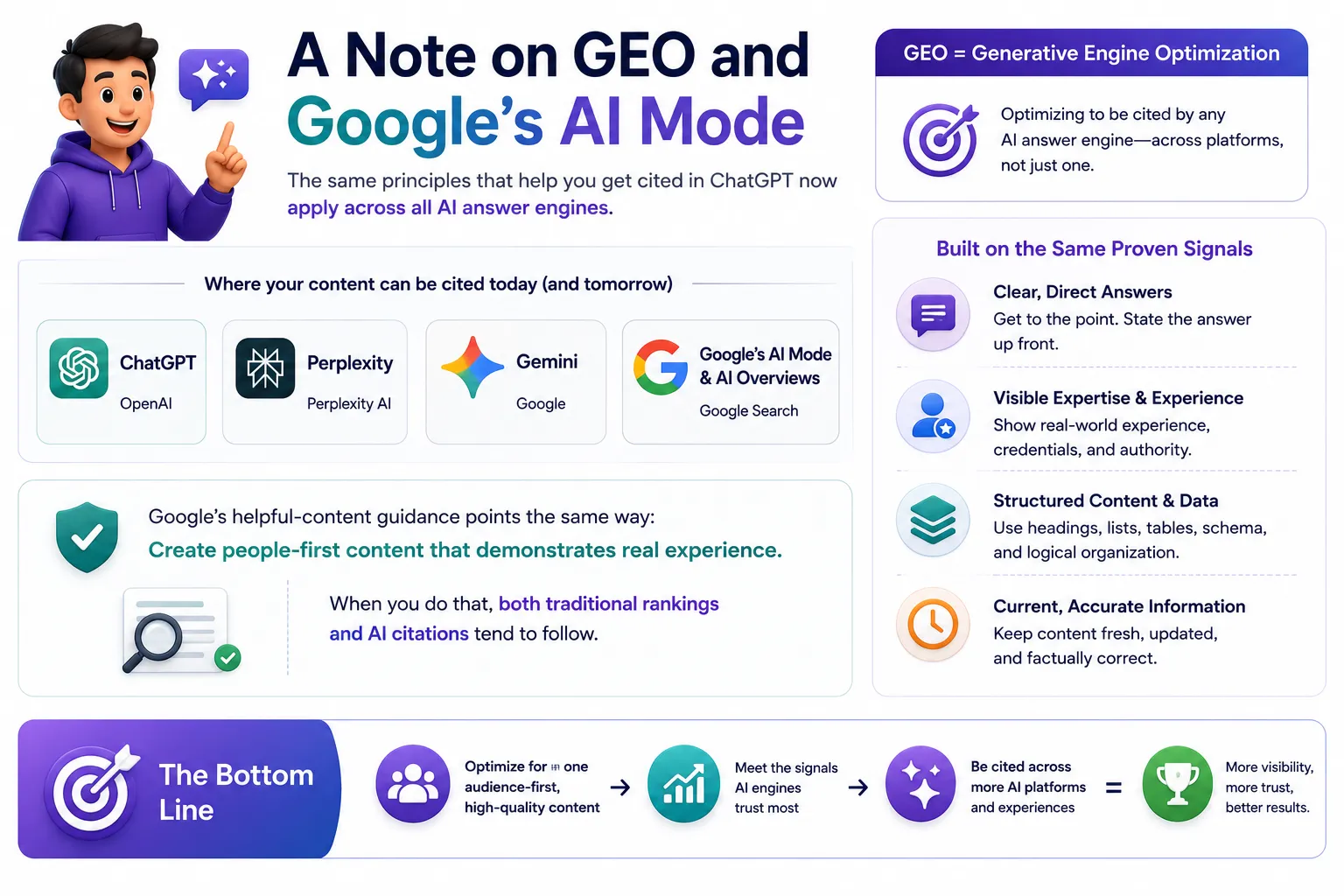
The same principles now extend beyond ChatGPT. Generative Engine Optimization (GEO) — optimizing to be cited by any AI answer engine, including Perplexity, Gemini, and Google's AI Mode and AI Overviews — runs on the same signals covered above: a clear direct answer, visible expertise, structured data, and current information. Google's own helpful-content guidance points the same way: create people-first content that demonstrates real experience, and both traditional rankings and AI citations tend to follow. Optimizing for one increasingly means optimizing for all of them.
Want to see how software brands apply these AI-visibility principles? Explore advertising options on AppLuxe, or browse the current SaaS deals to see how other software companies present and position themselves.

LoyAnn Sherwood is the CEO and Founder of AppLuxe. She spent approximately 25 years in the healthcare industry before transitioning to digital entrepreneurship. Sherwood founded AppLuxe in 2026 after acquiring the domain and identifying an opportunity to build a luxury-positioned app and software marketplace. She manages the platform's editorial direction and business development strategy.
Get first access to exclusive software reviews, hand-picked SaaS lifetime deals, and digital growth strategies delivered straight to your inbox. No spam, ever—just pure software value to scale your business.
57 subscribers have joined!
If you love lifetime SaaS deals as much as I do, then please subscribe to our monthly/weekly AppLuxe newsletter.
Marcus Vance, SaaS Specialist