Discover expert articles on AI, SaaS, software, marketing, SEO, affiliate marketing and startup growth.
Discover expert articles on AI, SaaS, software, marketing, SEO, affiliate marketing and startup growth.
By LoyAnn Sherwood
Published on Mar 23, 2026
1. What Exactly is Agentic AI?
2. The 2026 Shift: Why Now?
3. How Agentic AI Redefines Enterprise Efficiency
4. The Impact on the SaaS Landscape
5. Overcoming the “Trust Gap”: Governance and Safety
6. Strategic Checklist for Implementing Agentic AI
7. Key Takeaways: Mastering Agentic AI in 2026
8. Frequently Asked Questions (FAQ)
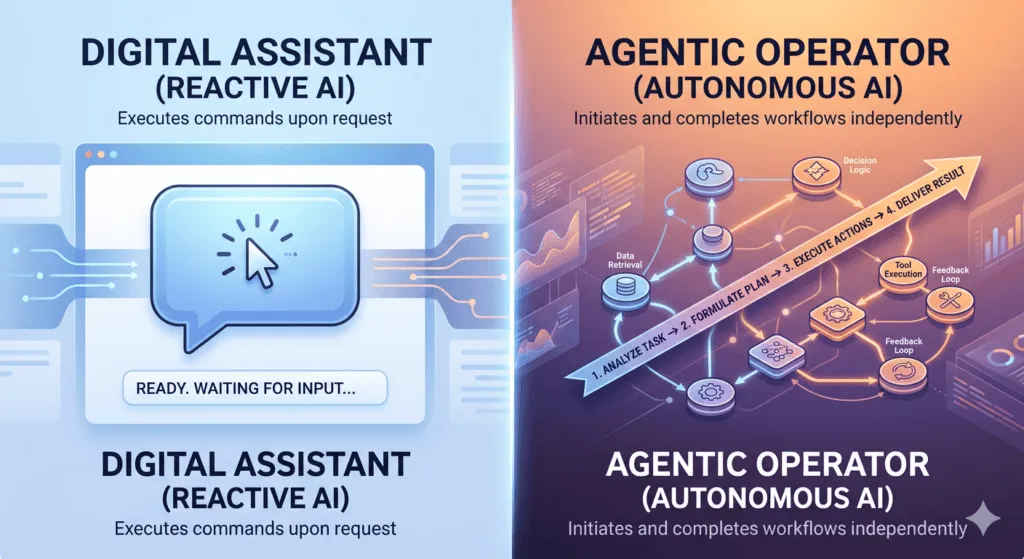
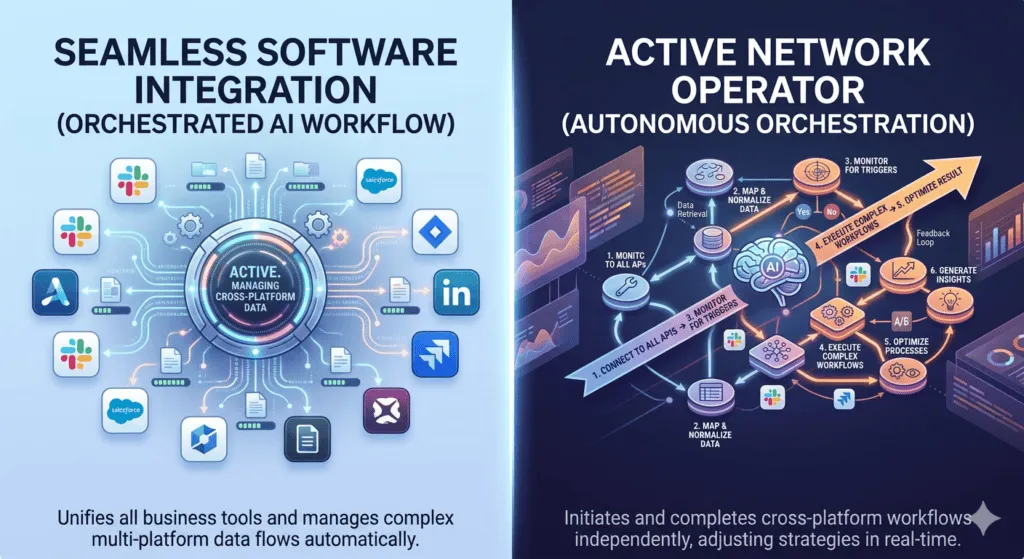
The digital landscape is currently witnessing its most significant shift since the birth of the cloud. For years, we have lived in the era of the “Digital Assistant”—think of chatbots that answer basic queries or AI writing tools that require constant human prompting. However, as we move through 2026, a new titan has emerged: Agentic AI. Unlike its predecessors, Agentic AI does not just talk; it acts. It has transitioned from a passive helper into a proactive business operator, capable of planning, executing, and optimizing complex multi-step workflows without constant human intervention.
For the modern enterprise and the evolving SaaS landscape, this represents a fundamental change in how work is done. We are moving away from software as a “tool” and toward software as a “teammate.”
To understand the magnitude of this shift, we must define the difference between generative AI and agentic systems. Generative AI, like the LLMs we became familiar with in 2023 and 2024, is largely reactive. You provide a prompt, and it provides an output.
Agentic AI, however, is characterized by autonomy. It is designed to achieve a high-level goal by breaking it down into smaller tasks, selecting the right tools for those tasks, and executing them in a logical sequence. If an obstacle arises, the agent iterates and finds a new path. It possesses a level of “reasoning” that allows it to operate as a self-contained unit within a business ecosystem.
Perception: The ability to monitor digital environments (emails, databases, market trends).
Reasoning/Planning: The capacity to create a roadmap to reach a specific KPI.
Action: The ability to interface with other software (APIs, CRM, ERP) to complete tasks.
Learning: The ability to analyze the results of its actions and improve the next workflow.
The transition to autonomous business operators didn’t happen overnight. It is the result of three converging technological milestones:
Large Action Models (LAMs): While LLMs focus on text, LAMs are trained on user interfaces and API documentation, allowing AI to “understand” how to click buttons and move data between apps.
Long-Term Context Windows: AI can now “remember” months of project history, allowing for consistent long-term execution.
Standardized API Ecosystems: With the rise of “Composable SaaS,” software is now built to be easily navigated by AI agents rather than just human eyes.
In the old model of enterprise efficiency, a human manager spent 60% of their time “stitching” software together—moving data from a marketing tool to a spreadsheet, then to an email drafter. Agentic AI eliminates this “glue work.”
In 2026, an AI Business Operator doesn’t just remind you of a deadline. It monitors the progress of a software build, identifies that a developer is behind on a sprint, automatically reallocates resources, and updates the stakeholders with a revised timeline and a summary of why the shift occurred.
Instead of a standard “email sequence,” an AI Agent observes a lead’s behavior across social media and your website. It then autonomously creates a unique landing page, generates a custom demo video, and schedules a meeting only when it identifies a “high-intent” signal—all without a marketing manager touching a keyboard.
For businesses involving physical goods, Agentic AI can monitor global shipping disruptions in real-time. If a port is blocked, the agent doesn’t just alert a human; it researches alternative routes, calculates the cost-benefit of air vs. sea freight, and presents a finalized re-routing plan for a simple “one-click” approval.
The SaaS industry is undergoing a “Great Re-platforming.” If your software isn’t “Agent-ready,” it is becoming obsolete.
For a decade, SaaS companies competed on who had the prettiest dashboard. Today, the competition is about who has the most robust “Agentic Interface.” SaaS platforms are being redesigned so that AI agents can navigate them faster than humans. We are seeing the rise of “headless” SaaS where the primary user is an AI, not a person.
As AI agents do the work of ten people, the traditional “price per seat” model is collapsing. SaaS providers are shifting toward Outcome-Based Pricing. Instead of paying for access to the software, enterprises pay for the successful completion of a task (e.g., a closed sale, a resolved support ticket, or a completed audit).
Generic AI is being replaced by hyper-specialized agents. We now see:
The AI General Counsel: Handling contract redlining and compliance.
The AI Comptroller: Managing real-time treasury and tax optimization.
The AI Product Manager: Turning user feedback directly into Jira tickets and wireframes.
Get first access to exclusive software reviews, hand-picked SaaS lifetime deals, and digital growth strategies delivered straight to your inbox. No spam, ever—just pure software value to scale your business.
60 subscribers have joined!
If you love lifetime SaaS deals as much as I do, then please subscribe to our monthly/weekly AppLuxe newsletter.
Marcus Vance, SaaS Specialist
The biggest hurdle for Agentic AI isn’t the technology—it’s the trust. Giving a piece of software the authority to spend company money or communicate with clients is a significant leap.
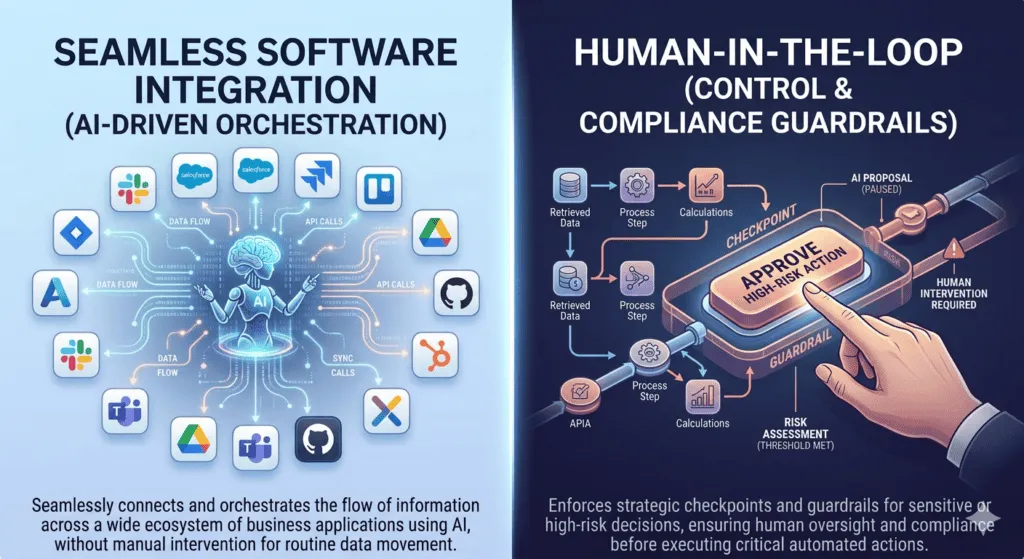
o solve this, 2026 has introduced “Human-in-the-Loop” (HITL) Guardrails. These are “checkpoints” where the AI agent must stop and ask for human verification before executing high-risk actions. Furthermore, Blockchain for AI Auditability is becoming standard, creating an immutable record of every decision an AI agent makes, ensuring total transparency for compliance offichuman-in-the-loopers.
If you are a business leader looking to transition from “Digital Assistants” to “Business Operators,” consider the following steps:
Identify Bottlenecks: Look for multi-step processes that involve more than three different software platforms.
Clean Your Data: AI agents are only as good as the data they access. Siloed or “dirty” data will lead to autonomous errors.
Adopt “Agent-First” Tooling: When purchasing new SaaS, ask the vendor: “How easily can an external AI agent navigate your platform?”
Define Your Guardrails: Determine which decisions are “Agent-Autonomous” and which require “Human-Approval.”
By the end of this decade, the distinction between “software” and “employee” will continue to blur. We will see the rise of Multi-Agent Systems (MAS), where your AI Marketing Agent talks to your AI Finance Agent to negotiate a budget for a new campaign—all while the human CEO focuses on high-level vision and creative direction.
Agentic AI is not here to replace human ingenuity; it is here to liberate it. By taking over the role of the “Business Operator,” these systems allow humans to return to what we do best: innovating, empathizing, and leading.
The transition from reactive digital assistants to autonomous business operators marks a new era in enterprise efficiency. By leveraging agentic AI systems, businesses can now achieve seamless software integration across platforms like Slack, Salesforce, and Jira. These AI agents autonomously manage multi-step business workflows, reducing the need for manual data movement and allowing your team to focus on high-level strategy.
However, moving toward an autonomous business roadmap requires more than just raw power; it demands strategic human oversight. Implementing guardrails ensures that every high-risk business decision is met with a mandatory checkpoint for control and compliance.
As we look toward the 2026 SaaS landscape, success lies in balancing this AI-driven orchestration with robust governance and safety. By adopting an agent-first approach with built-in risk assessment thresholds, enterprises can scale rapidly while maintaining total transparency and security in their digital operations.
The shift from digital assistants to autonomous business operators is the ultimate evolution of productivity. As Agentic AI takes hold of the enterprise, the businesses that thrive will be those that stop viewing AI as a “search bar” and start viewing it as a “workforce.” The era of the autonomous enterprise is here. Are you ready to hand over the keys?
Traditional AI (like basic chatbots) is reactive and waits for a prompt. Agentic AI is proactive; it can autonomously plan, reason, and execute multi-step workflows to achieve a high-level business goal without constant human input.
As shown in the “Seamless Software Integration” graphic, it is the process where an AI agent acts as a central brain, automatically managing data flow and API calls between different apps like Slack, Salesforce, and Jira.
HITL is a safety framework that requires human intervention for high-risk decisions. It ensures that while the AI does the heavy lifting, a human must manually click “Approve” for critical actions, ensuring control and compliance.
Yes, for routine data movement and standard process steps, Agentic AI operates autonomously. However, strategic guardrails are set to pause the AI when it encounters a task that exceeds a specific risk assessment threshold.
It eliminates “glue work“—the manual task of moving information between software platforms. By automating these connections, enterprises can execute complex projects faster and with fewer errors.
These are pre-defined rules and checkpoints that restrict what an AI agent can do. They ensure the AI follows company policy, legal requirements, and security protocols before executing any sensitive automated actions.
Most modern SaaS platforms with robust APIs (like Microsoft Teams, GitHub, HubSpot, and Salesforce) can be orchestrated by an AI agent to create a unified digital ecosystem.
It is a safety metric used to evaluate a task’s potential impact. If a task is deemed “High-Risk” (like a large financial transfer), the AI proposal is paused until a human provides the necessary “Approve” signal.
Rather than replacing humans, it shifts the human role from “execution” to “governance.” Humans move from doing repetitive data tasks to acting as strategic overseers who provide final authorization on AI-led plans.
Start by identifying multi-step processes that currently require manual data entry between apps. Look for “Agent-ready” SaaS tools and implement a “Human-in-the-Loop” dashboard to manage the AI’s autonomous actions safely.
The shift toward Agentic AI isn’t just coming—it’s already here. Don’t let your business get left behind in the era of manual workflows.
Weekly Deep-Dives: Stay ahead with the latest in autonomous SaaS and AI-driven orchestration.
Executive Guides: Exclusive checklists for implementing “Human-in-the-Loop” guardrails.
Market Insights: Early access to 2026’s most promising app marketplaces.
[ Subscribe to the Newsletter ] | [ Book an AI Strategy Consultation ]
[rafflepress id=”1″]


LoyAnn Sherwood is the CEO and Founder of AppLuxe. She spent approximately 25 years in the healthcare industry before transitioning to digital entrepreneurship. Sherwood founded AppLuxe in 2026 after acquiring the domain and identifying an opportunity to build a luxury-positioned app and software marketplace. She manages the platform's editorial direction and business development strategy.
Get first access to exclusive software reviews, hand-picked SaaS lifetime deals, and digital growth strategies delivered straight to your inbox. No spam, ever—just pure software value to scale your business.
60 subscribers have joined!
If you love lifetime SaaS deals as much as I do, then please subscribe to our monthly/weekly AppLuxe newsletter.
Marcus Vance, SaaS Specialist