Discover expert articles on AI, SaaS, software, marketing, SEO, affiliate marketing and startup growth.
Discover expert articles on AI, SaaS, software, marketing, SEO, affiliate marketing and startup growth.
By LoyAnn Sherwood
Published on Jun 24, 2026

"App and SaaS affiliate marketing dashboard showing recurring revenue growth between mobile and desktop platforms"
If you've spent any time promoting physical products, you already know the math rarely works in your favor. You drive the traffic; you do the convincing, and at the end of the month you're left with a commission that barely covers your ad spend. App and SaaS affiliate marketing flips that equation entirely and once you understand how the mechanics actually work, it's hard to go back to anything else.
This guide breaks down exactly how software affiliate programs are built, tracked, and scaled, from both sides of the table: the developer building the program and the affiliate driving the traffic. By the end, you'll understand not just why app and SaaS partnerships outperform physical retail, but how the underlying attribution technology, recruitment strategy, and traffic funnels actually fit together and where this industry is heading next.
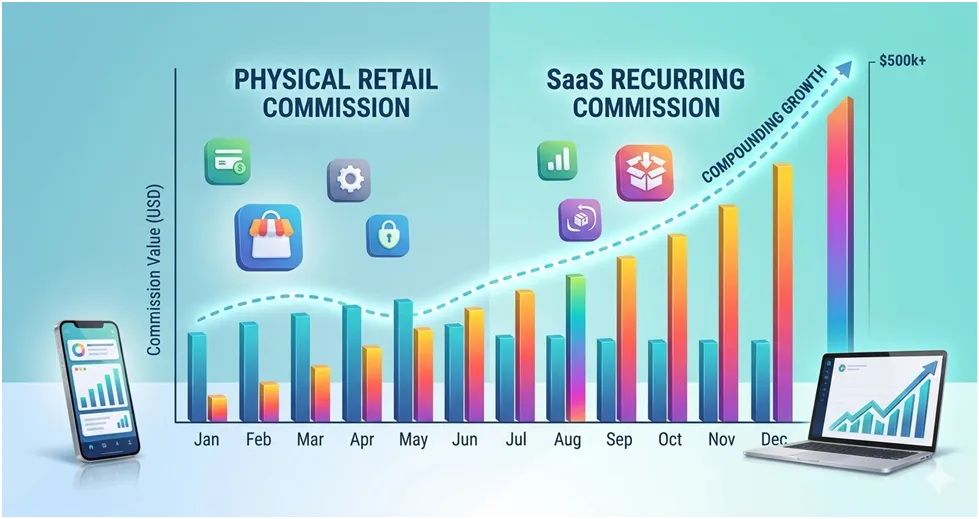
ALT TEXT: "Bar chart comparing one-time physical retail affiliate commission versus recurring SaaS affiliate commission over 12 months"
Physical retail affiliate programs are built on razor-thin margins. Amazon Associates, still the default starting point for most new affiliates, pays out commissions as low as 1–4% on most categories. That structure exists because Amazon's own margins on physical goods are thin to begin with there are manufacturing, shipping, warehousing, and returns eating into every sale.
Software doesn't carry that overhead. Once an app or SaaS platform is built, the marginal cost of serving one more customer is close to zero. That's why software companies routinely pay affiliates 30%, 50%, even 90% of the sale value. They can afford to, because the product itself runs on 70–90% gross margins. When a developer hands an affiliate half of that margin, both sides still win.
The bigger advantage isn't the size of a single commission it’s what happens after that first sale. A physical product commission is a one-time event. A SaaS commission, when the program includes recurring or lifetime payouts, keeps paying out for as long as that customer stays subscribed.
Here's what that difference looks like in practice:
| Col 1 | Col 2 | Col 3 |
|---|---|---|
| Month 1 | $50 | $50 |
| Month 6 | $50 (no further payout) | $300 |
| Month 12 | $50 (no further payout) | $600 |
A single referred customer who sticks around for a year is worth twelve times more under a recurring model than a one-time retail sale without the affiliate lifting a finger after the initial conversion. That compounding effect is the entire reason serious affiliates are migrating away from physical retail and toward app and SaaS partnerships.
There's a second layer to this math that's easy to overlook: churn. A recurring commission only compounds for as long as the referred customer stays subscribed, which means affiliates are increasingly selective about which software they promote. A product with strong retention and a low monthly churn rate effectively pays its affiliates a higher lifetime commission than a product with a flashier upfront payout but a leaky retention funnel. Smart affiliates have started asking developers for churn data before committing their traffic and smart developers now share it, because strong retention is a competitive advantage in recruitment, not just in product quality.
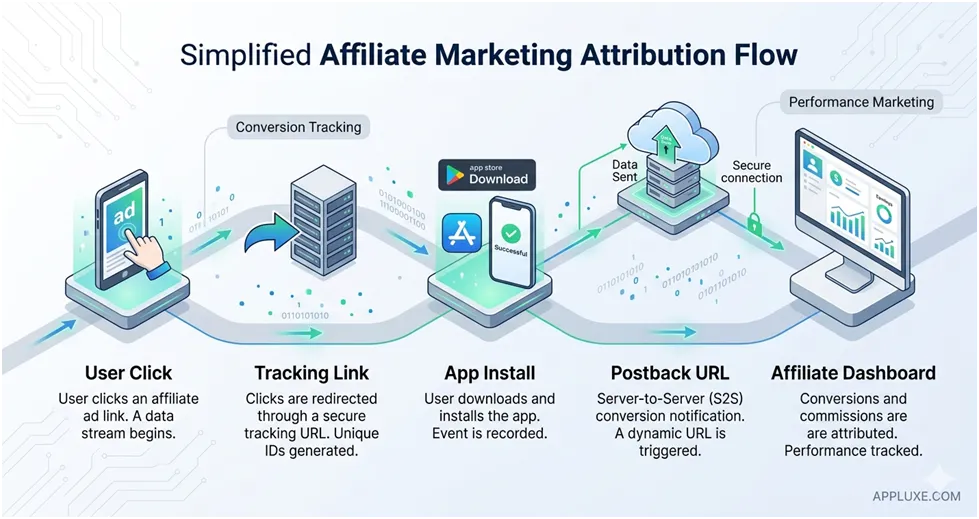
ALT TEXT: "Diagram of SaaS affiliate attribution flow from tracking link click to postback URL confirmation"
Not all software commission structures are built the same way, and understanding the difference matters before you commits your traffic to a program.
• CPA (Cost-Per-Acquisition): A fixed, one-time payout triggered by a specific action — a free trial signup, a completed install, or a first purchase. This model is predictable and front-loads earnings, which makes it attractive for affiliates running paid traffic who need fast payback on ad spend.
• Rev-Share (Revenue Share): A percentage of what the referred customer pays, for as long as they remain subscribed. This is where the long-term compounding value discussed above actually materializes. It rewards affiliates who promote products their audience genuinely sticks with.
• Hybrid Models: A combination of both — a smaller upfront CPA payment plus an ongoing rev-share percentage. This structure is increasingly common because it satisfies both audiences: affiliates who need cash flow now, and affiliates building a long-term passive income stream.
The right model depends on the affiliate's traffic type and the developer's customer lifetime value (LTV). A high-LTV SaaS product can afford generous rev-share terms; a low-cost utility app may lean on CPA instead.
Third-party cookies are dying, and most affiliates already feel the impact in shrinking attribution windows. Modern app and SaaS programs have moved past cookie-based tracking entirely, relying instead on infrastructure that survives browser restrictions and app-store sandboxing:
• Post back URLs fire a server-side notification the instant a conversion event happens, independent of the user's browser or device.
• Server-to-Server (S2S) API web hooks pass conversion data directly between the advertiser's server and the affiliate network, eliminating the client-side tracking pixels that ad blockers and privacy settings routinely strip out.
• Deep-linking sends a referred user directly to a specific in-app screen or on boarding step, preserving attribution data even when the user jumps from a browser to a native app.
For an affiliate, this matters enormously: if a program's tracking is fragile, commissions silently disappear. A trustworthy software affiliate program is one where the technical backbone not just the payout terms, has been built to hold up under real-world conditions.
It's also worth noting that attribution windows themselves have become a negotiating point. A program offering a 30-day cookie-less attribution window, backed by S2S tracking, gives affiliates far more confidence than one offering a 24-hour window with no fallback. Before committing significant traffic, affiliates should ask developers directly how conversions are tracked, what the attribution window looks like, and whether the program offers a real-time dashboard to verify that clicks are actually being recorded, not just trust the payout numbers at face value.
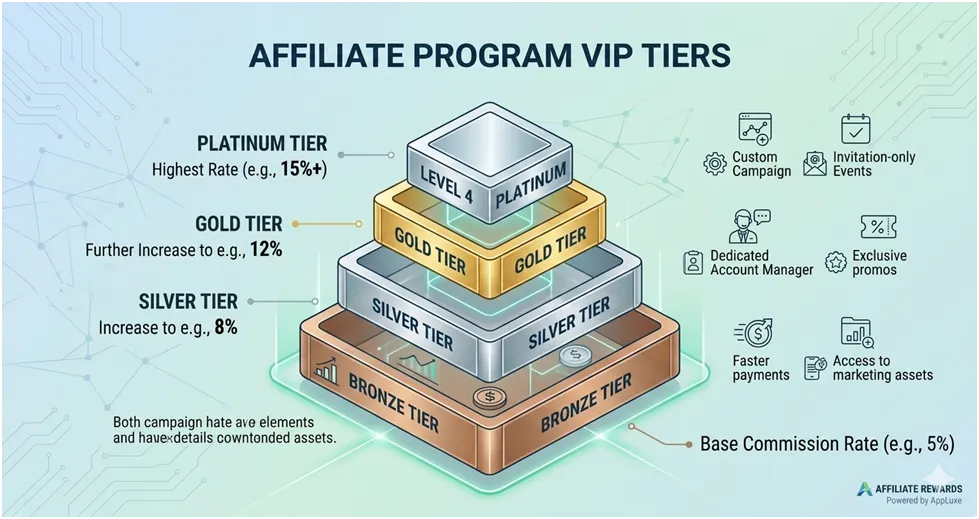
ALT TEXT: "Tiered affiliate commission structure showing increasing payout percentages from bronze to platinum level"
Most of the volume in any affiliate program comes from a small fraction of its affiliates. Developers who understand this build their entire recruitment strategy around attracting and retaining that top tier, rather than chasing volume from hundreds of inactive sign-ups.
Top affiliates don't have time to build promotional assets from scratch for every program they join. The programs that win their attention are the ones that hand them a ready-to-use stack on day one: pre-written swipe copy for email and social, interactive product demo videos, and customizable landing page templates that already match high-converting layouts.
This isn't a nice-to-have. It's the difference between an affiliate testing your offer this week versus shelving it for "later" indefinitely.
Flat commission rates treat your best affiliate the same as your newest one and that's a missed opportunity. Tiered structures that scale payouts based on monthly volume give top performers a direct incentive to push your software into their best-performing ad placements and highest-traffic content slots, instead of treating it as just another link in a sidebar.
A simple example: a base 30% rev-share that climbs to 40% after 20 monthly sales, and 50% after 50. The jump doesn't just reward loyalty it actively changes affiliate behavior, encouraging them to prioritize your offer over a competitor's.
Beyond the commission structure itself, the on boarding sequence matters more than most developers realize. The first 48 hours after an affiliate signs up determine whether they ever send traffic at all. Programs that automatically deliver the marketing stack, assign a dedicated affiliate manager contact, and confirm tracking is live within that window see dramatically higher activation rates than programs that leave new affiliates to figure things out on their own.
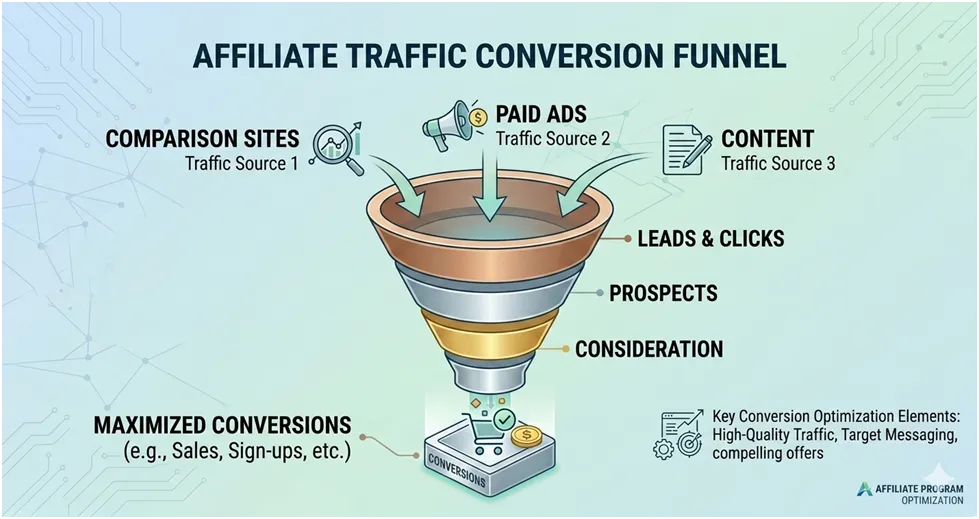
" ALT TEXT: "Marketing funnel diagram showing comparison sites and paid ads converting into software affiliate sales"
The highest-converting traffic in software marketing isn't cold it's already searching with intent. "[Competitor] alternatives," "[Tool A] vs [Tool B]," and "best [category] software" searches represent users actively comparing options and ready to make a decision. Affiliates who build comparison hubs and dedicated alternative-to pages position themselves directly in that decision-making moment, rather than trying to manufacture demand from scratch.
This content format also compounds in search engine value over time. A well-structured comparison page ranks for dozens of long-tail variations, turning a single piece of content into a durable traffic asset.
Paid traffic can scale a software affiliate offer far faster than organic content alone, but it comes with guardrails that many new affiliates overlook. Most programs explicitly prohibit bidding on the brand's own name in Google Ads or Meta Ads doing so usually results in immediate termination from the program, since it cannibalizes the developer's own paid search traffic instead of generating incremental sales.
The safer, more sustainable approach is to build campaigns around category and problem-aware keywords, then route that traffic through a bridge or pre-sell page rather than linking directly to the software's homepage. This pre-sell layer warms up the visitor, reinforces the value proposition in your own voice, and tends to convert measurably better than a cold click straight to a generic landing page.
Retargeting adds another layer of efficiency on top of this. Most visitors won't convert on the first visit, especially for subscription software that requires a degree of trust before someone hands over payment details. A pixel placed on the pre-sell page fully compliant with the program's terms lets affiliates re-engage warm visitors with testimonials, limited-time incentives, or feature comparisons in a second or third touch point, often at a fraction of the cost of fresh top-of-funnel traffic.
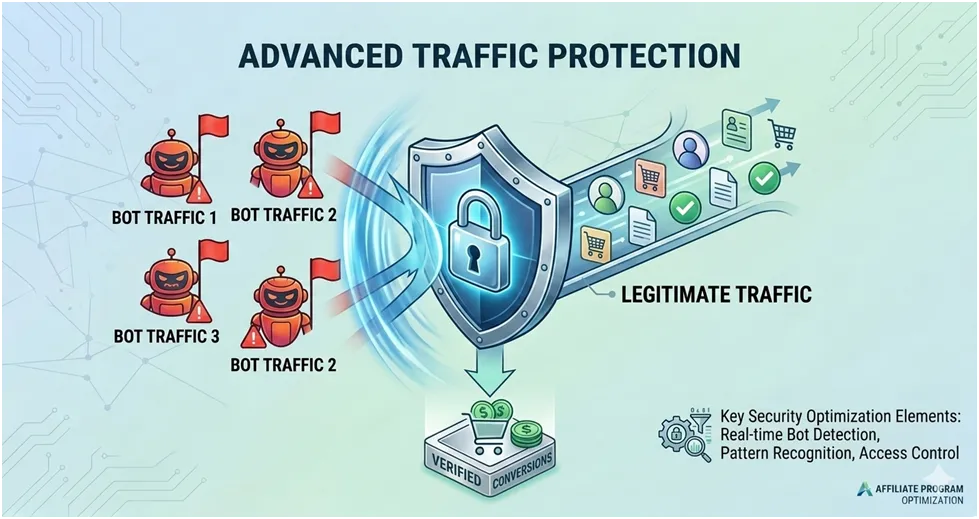
ALT TEXT: "Fraud prevention shield blocking bot traffic and fake installs from a SaaS affiliate tracking system"
Affiliate fraud isn't a hypothetical risk it's one of the fastest ways a software program loses developer trust and shuts down. Fake installs generated through device emulators, proxy traffic designed to mask click origin, and bot-driven signups all inflate affiliate payouts without delivering a single real user.
Get first access to exclusive software reviews, hand-picked SaaS lifetime deals, and digital growth strategies delivered straight to your inbox. No spam, ever—just pure software value to scale your business.
60 subscribers have joined!
If you love lifetime SaaS deals as much as I do, then please subscribe to our monthly/weekly AppLuxe newsletter.
Marcus Vance, SaaS Specialist
Programs that survive long-term build fraud filtering directly into their tracking infrastructure: IP and device fingerprinting, install-to-engagement ratio monitoring, and automatic flagging of conversion patterns that don't match real human behavior. For affiliates, working with a program that takes fraud seriously isn't a restriction it's protection. It keeps the commission pool intact for everyone playing by the rules.
Compliance extends beyond fraud detection into data privacy as well. Affiliates running paid traffic into the EU or other regulated markets need landing pages with proper cookie consent banners and clear data-handling disclosures not just to satisfy regulators, but because Google and Meta increasingly restrict ad delivery for pages that skip this step. A program built on outdated, non-compliant page templates puts every affiliate using it at risk of ad account suspensions that have nothing to do with the affiliate's own behavior.
It's easy to treat technical page performance as a developer's problem rather than a marketer's problem, but in affiliate marketing the two is inseparable. A bloated, slow-loading landing page doesn't just hurt search rankings it actively kills conversion rates before a visitor ever reads the pitch. Every additional second of load time gives a high-intent visitor more time to bounce.
Clean, minimal code, compressed assets, and mobile-first layouts aren't cosmetic choices. They're revenue decisions. The affiliates and developers who treat page speed and structured, crawl able code as core to the strategy not an afterthought consistently outperform those who don't.

ALT TEXT: "Centralized app and SaaS marketplace connecting scattered individual affiliate programs into one unified hub"
Right now, most affiliates managing a software portfolio are juggling a dozen separate dashboards, a dozen separate payout schedules, and a dozen separate sets of tracking links one for every individual program they've joined. That fragmentation isn't just inconvenient; it's a structural inefficiency that costs both sides money. Developers lose visibility into which affiliates are actually performing across the ecosystem, and affiliates waste time managing logistics instead of producing content.
A centralized marketplace solves this at the root. Instead of scattered, disconnected programs, both users and affiliates get one trusted hub with consistent tracking, consistent payout terms, and a single point of discovery.
This is exactly the gap Appluxe is built to close. Rather than forcing developers to build fragmented, standalone affiliate infrastructure and forcing affiliates to manage a sprawling list of disconnected programs, Appluxe is being designed as a single, unified marketplace where high-quality apps and SaaS products are discoverable, track able, and promotable from one clean ecosystem built on exactly the kind of bulletproof attribution and fraud-resistant infrastructure outlined throughout this guide.
For developers, that means launching an affiliate program without building tracking, fraud filtering, and a marketing-asset library from scratch. For affiliates, it means one login, one payout schedule, and one trusted source of vetted, high-converting software instead of chasing down a dozen separate programs with inconsistent terms and unreliable tracking. The goal isn't to add another middleman to an already crowded space; it's to remove the fragmentation that's been quietly taxing both sides of this industry for years.
Be first in line. Whether you're a developer looking to launch a high-converting affiliate program without building the infrastructure from scratch, or an affiliate looking for one trusted hub instead of a dozen scattered dashboards, Appluxe is built for you.
Join the Appluxe Marketplace Waitlist →
App and SaaS affiliate marketing rewards the people who understand the mechanics behind it the margins, the attribution infrastructure, the recruitment strategy, and the technical compliance that keeps a program trustworthy at scale. Get those fundamentals right, and the recurring revenue loop does the heavy lifting for you, month after month, long after the original sale.
The next step is choosing where to build that strategy. A centralized, well-engineered marketplace removes the fragmentation that's slowed this industry down for years and that's exactly what's coming next.
ALT TEXT: "Frequently asked questions about app and SaaS affiliate marketing illustrated with a speech bubble and laptop icon"
1. What is SaaS affiliate marketing and how is it different from regular affiliate marketing?
SaaS affiliate marketing is a partnership model where you earn commissions by referring paying customers to software products — most commonly subscription-based apps or cloud platforms. The key difference from traditional affiliate marketing is the payout structure. In physical retail affiliate programs, you earn a one-time commission per sale, usually 1–10%. In SaaS affiliate programs, you frequently earn a recurring percentage of the subscription fee every single month the customer you referred stays subscribed. That recurring model can turn a single referral into months or years of passive income, which is why SaaS affiliate partnerships have become the preferred model for serious content marketers and performance marketers alike.
2. How much commission can I realistically earn from a SaaS affiliate program?
Commission rates vary widely by product, but software programs are structurally more generous than physical retail because their gross margins are so much higher. Entry-level programs typically offer 20–30% recurring revenue share. Premium programs, especially those with high-ticket pricing or aggressive growth targets, can offer 40–50% or more. On the CPA side, one-time payouts for free-trial conversions or paid installs typically range from $10 to $200 depending on the product's average customer lifetime value. The most important figure to calculate isn't the commission rate alone — it's the commission rate multiplied by the average subscription price, multiplied by the product's average customer retention. That combined figure is your true earning potential per referred customer.
3. Do I need a large audience to succeed as a SaaS affiliate?
No. Audience size matters far less than audience intent and relevance. A blog with 5,000 monthly readers who are all actively searching for project management tools will consistently outperform a generalist site with 500,000 visitors when it comes to converting software sales. The highest-converting SaaS affiliates tend to be niche-specific: software review sites, developer tutorials, productivity YouTube channels, and comparison hubs. If your content attracts people who are already in the market for a specific category of software, you have the foundation needed to earn meaningful commissions — regardless of your overall traffic numbers.
4. What tracking technology should I look for in a SaaS affiliate program before I join?
Before committing your traffic to any program, verify that it uses server-to-server (S2S) tracking or postback URL-based attribution rather than relying solely on browser cookies. Cookie-based tracking is increasingly unreliable — privacy updates in Safari, Firefox, and Chrome, combined with widespread ad blockers, mean that a significant portion of conversions tracked only via cookies simply disappear. Programs built on S2S webhooks and postback URLs log conversions at the server level, independent of the user's browser behavior. Also look for a real-time reporting dashboard so you can verify clicks are being logged before you invest significant traffic into a program.
5. What is the difference between CPA, rev-share, and hybrid commission models?
These three models represent different ways developers structure affiliate payouts. CPA (Cost-Per-Acquisition) pays a fixed amount for each qualifying action — typically a trial signup, first payment, or install. Rev-share pays a percentage of what the customer pays on a recurring basis, for as long as they stay subscribed. Hybrid models combine both: a smaller upfront CPA payment to reward the affiliate immediately, plus an ongoing rev-share percentage that builds passive income over time. For affiliates running paid traffic, CPA provides faster ROI on ad spend. For affiliates building content-driven or SEO-driven channels, rev-share offers better long-term value. Hybrid models are increasingly popular because they work well for both traffic types simultaneously.
6. How do I protect myself as an affiliate from programs that don't pay out accurately?
There are several practical steps you can take. First, only work with programs that offer real-time tracking dashboards, so you can verify that clicks and conversions are being logged as they happen. Second, check the program's payment history and reputation in affiliate marketing forums and communities before investing serious traffic. Third, look for programs that use established affiliate network infrastructure — platforms with dedicated fraud detection are less likely to have "leaky" tracking. Finally, read the payout terms carefully: some programs include clawback clauses that allow them to reverse commissions due to refunds or chargebacks. Understanding those terms upfront prevents unpleasant surprises when your first payment arrives.
7. Can I run paid ads to promote SaaS affiliate offers?
Yes, but with important caveats. Most SaaS affiliate programs prohibit bidding on the brand's own name or trademark variations in Google Ads or Meta Ads, because it competes directly with the developer's own paid search campaigns. Violating this is one of the most common causes of affiliate termination. The compliant and sustainable approach is to target category-level, problem-aware, or competitor-comparison keywords, then direct traffic to a pre-sell bridge page rather than linking directly to the software's homepage. This setup warms up the visitor, keeps your tracking parameters intact, and avoids the trademark violations that get affiliates banned. Always read a program's paid traffic policy in full before launching any campaigns.
8. How long does it take to start earning money from SaaS affiliate marketing?
The honest answer depends heavily on your traffic channel. Affiliates running paid ads to an established offer can see conversions within days, though the economics only work if the lifetime commission value exceeds the cost to acquire the click. For SEO-driven content affiliates — comparison pages, review articles, alternative-to hubs — expect a minimum of 3–6 months before organic rankings build enough traffic to generate consistent commissions. The long-term ceiling for content-based SaaS affiliates is significantly higher, since those rankings compound in value over time, but the ramp-up period requires patience. A hybrid approach — using a small paid traffic budget to validate an offer while building SEO content in parallel — is the most capital-efficient path for most new affiliates.
9. What types of content convert best for SaaS affiliate marketing?
The highest-converting content formats are consistently those that intercept users who are already close to a buying decision. These include head-to-head comparison articles (Tool A vs Tool B), "best [software category] for [use case]" roundups, and "alternatives to [competitor]" pages targeting users who are already dissatisfied with a competing product. Detailed, honest review articles with genuine pros and cons also perform well because they build trust with readers who are conducting due diligence before subscribing. Tutorial content — "how to set up X" or "how to use X for Y" — converts well because it attracts users at the exact moment they've already decided to use the software and are just looking for guidance on getting started.
10. What is affiliate fraud, and how does it affect my earnings?
Affiliate fraud occurs when bad actors inject fake conversions into a program — through bot clicks, device emulators that simulate installs without a real user, or proxy traffic that disguises its origin. For legitimate affiliates, fraud matters because it depletes the commission budget and can trigger stricter scrutiny of all affiliates in the program, including those doing nothing wrong. In severe cases, widespread fraud causes developers to shut down their programs entirely. Working with programs that have active fraud-detection infrastructure — IP fingerprinting, install-to-engagement monitoring, and real-time anomaly detection — protects the earning environment for everyone operating legitimately.
11. Is it better to join an individual SaaS affiliate program or a centralized affiliate marketplace?
Both approaches have real trade-offs. Individual programs can offer higher commission rates and more direct relationships with the developer, but managing five, ten, or twenty separate programs means juggling separate dashboards, separate tracking links, separate payout schedules, and inconsistent reporting standards. Centralized marketplaces solve the operational fragmentation problem by consolidating multiple programs into a single dashboard with unified tracking, standardized payout terms, and a curated catalog of vetted software. For affiliates scaling across multiple software verticals, a marketplace with consistent infrastructure is far more efficient. For developers, launching on a marketplace provides immediate access to an established affiliate base without the overhead of building and maintaining program infrastructure from scratch.
12. What makes Appluxe different from existing SaaS affiliate networks?
Appluxe is being built to address the specific fragmentation problem that existing affiliate networks haven't fully solved for the software and app category. Rather than hosting a broad mix of physical and digital products under one roof, Appluxe is designed as an app-first marketplace — purpose-built for high-quality SaaS and mobile app transactions, with attribution infrastructure, fraud filtering, and marketing asset delivery built into the platform from day one. For developers, that means launching with a complete affiliate infrastructure already in place. For affiliates, it means a single hub where every listed product has been vetted for quality and conversion potential, with tracking that's been engineered specifically for the app ecosystem rather than adapted from a model built for physical retail. Early access is available on the waitlist at appluxe.com.

LoyAnn Sherwood is the CEO and Founder of AppLuxe. She spent approximately 25 years in the healthcare industry before transitioning to digital entrepreneurship. Sherwood founded AppLuxe in 2026 after acquiring the domain and identifying an opportunity to build a luxury-positioned app and software marketplace. She manages the platform's editorial direction and business development strategy.
Get first access to exclusive software reviews, hand-picked SaaS lifetime deals, and digital growth strategies delivered straight to your inbox. No spam, ever—just pure software value to scale your business.
60 subscribers have joined!
If you love lifetime SaaS deals as much as I do, then please subscribe to our monthly/weekly AppLuxe newsletter.
Marcus Vance, SaaS Specialist