Discover expert articles on AI, SaaS, software, marketing, SEO, affiliate marketing and startup growth.
Discover expert articles on AI, SaaS, software, marketing, SEO, affiliate marketing and startup growth.
By LoyAnn Sherwood
Published on Jul 30, 2026
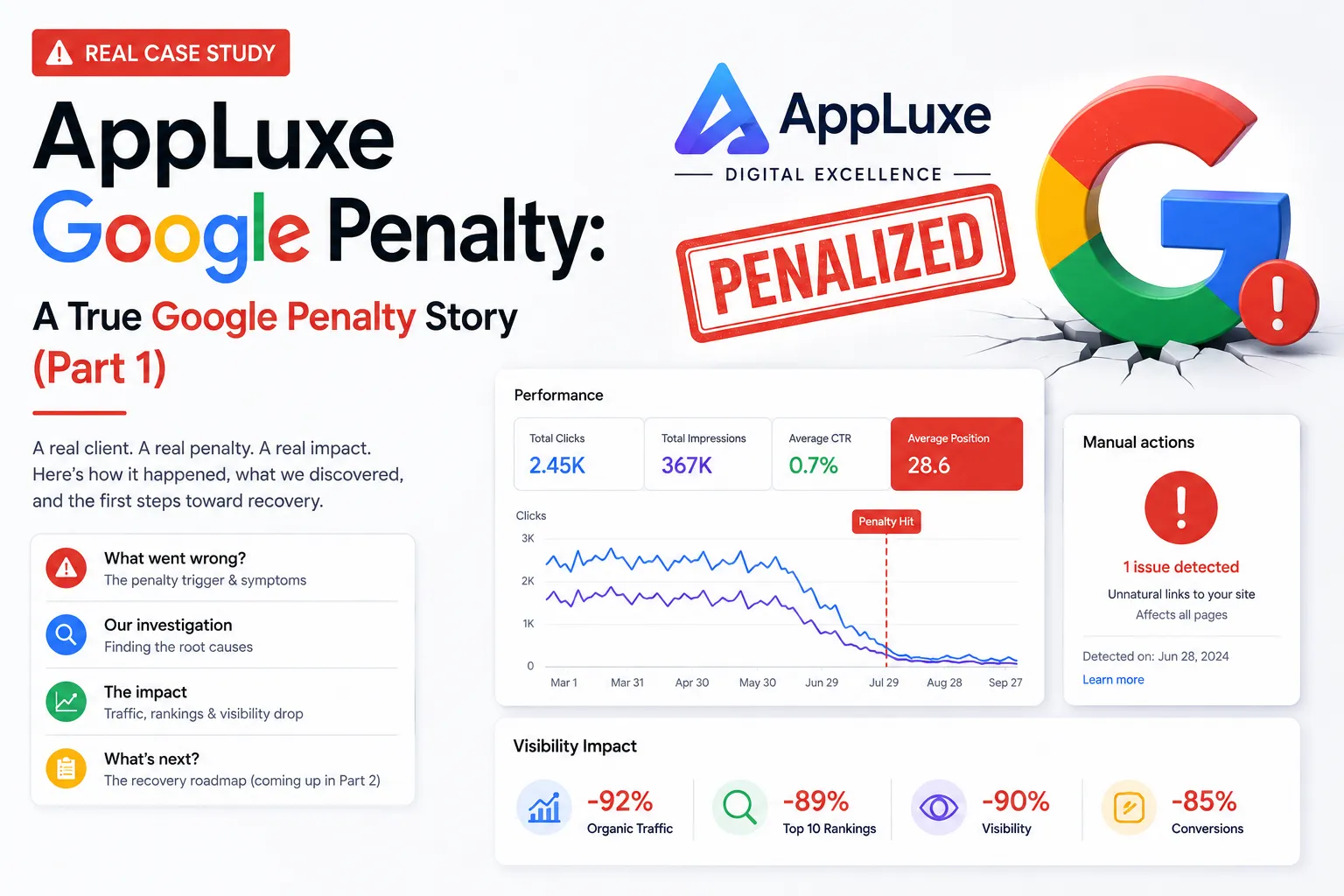
AppLuxe went from a healthy site to zero organic traffic after a Google penalty. The cause was not one thing - it was an unplanned migration, thin AI-generated content, and a pile of low-quality backlinks, all landing at once. This is the honest story of what happened, and what we are doing to recover. It is not finished yet.
Most articles about a Google penalty are written by people who never had one. This is not that. This is AppLuxe's own story, told while we are still living it.
A while back, AppLuxe had a domain rating in the 70s and a solid-looking profile. On paper, it looked strong. In reality, the organic traffic sat at zero. No keywords ranking. No clicks. Nothing. If you have ever watched a site you care about go quiet like that, you know the feeling in your stomach.
So we did the un-glamorous thing. We stopped guessing and started digging. Here is what we found - mistakes and all.
A Google penalty rarely arrives with a warning email. More often, the traffic just stops. One month you have visitors, the next you are staring at a flat line and wondering what you did.
In our case, there was no manual action flag in Search Console - no official 'you broke a rule' notice. That made it trickier. It meant the drop came from an algorithmic re-rating, most likely tied to a core update, rather than a single obvious violation. The site simply stopped being trusted enough to rank.
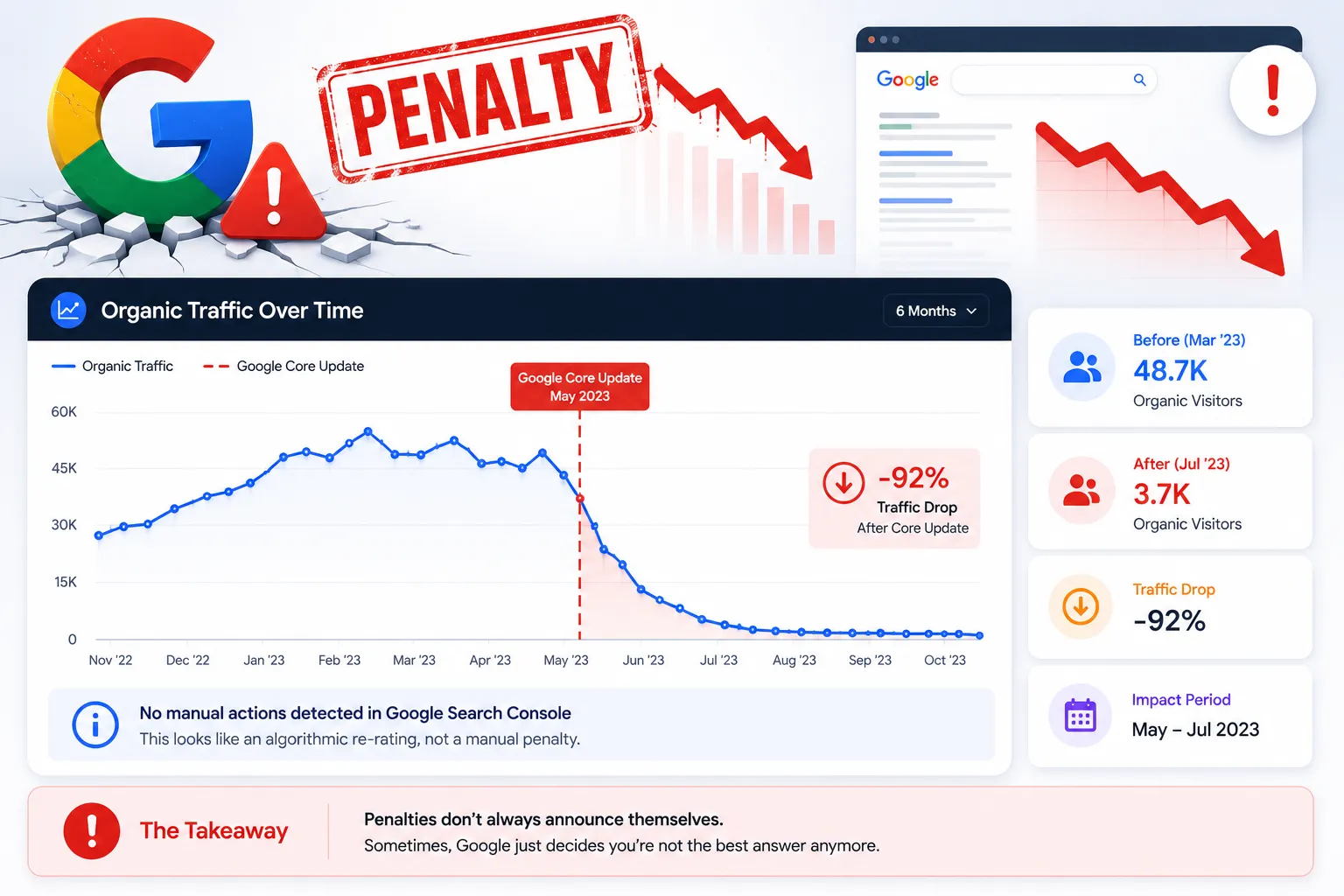
There was no single villain here. Three problems stacked on top of each other, and together they were enough to sink the whole site. Being honest about them is the only way this story is useful to anyone else.
This was the big one. The site was rebuilt and moved without a proper plan. URLs changed, canonical tags pointed to the wrong places, and hundreds of pages started returning errors. Every time Google crawled and hit a dead end, a little more trust drained away. If you take one lesson from this, let it be that: never migrate a site without mapping every URL first.
A chunk of the content had been produced quickly with AI and published without real editing or expertise behind it. It was not terrible - but it was not distinctive either. And Google's recent updates are ruthless with content that reads like a rehash of what already exists. Helpful, first-hand content survives; filler does not.
The backlink profile looked busy but hollow. Most links were no-follow, many were tool-generated, and a good share had already decayed or been removed. High link counts, almost no real authority. When a core update looks at a footprint like that, it sees signals of manipulation, not merit.
Here is the part that stung: none of these were bad luck. They were choices - shortcuts that felt efficient at the time and quietly compounded into a penalty.
Get first access to exclusive software reviews, hand-picked SaaS lifetime deals, and digital growth strategies delivered straight to your inbox. No spam, ever—just pure software value to scale your business.
57 subscribers have joined!
If you love lifetime SaaS deals as much as I do, then please subscribe to our monthly/weekly AppLuxe newsletter.
Marcus Vance, SaaS Specialist
It also reframed how we think about content going forward. We started asking a harder question about every page: would an AI engine actually cite this? That shift is worth understanding on its own - we broke it down in our guide on how ChatGPT chooses its sources, because the same qualities that earn an AI citation are the ones that earn Google's trust back.
Recovery is not one heroic fix. It is a series of unglamorous, deliberate steps. Here is the real plan we are working through:
Underpinning all of it is one principle Google keeps repeating in its helpful-content guidance: build for people first, and the rankings follow. We are done chasing shortcuts.
Are we seeing movement? A little. Pages have started to reappear in Google, and on the AI side, ChatGPT already recognises and cites AppLuxe by name. Those are encouraging signs.
But we are being honest with ourselves. A few pages returning is not a recovery. The real test is whether the indexed count climbs and holds - and we are not there yet. So no victory lap. Not until it is earned.
If you want to see the kind of content we are rebuilding around, our expert SaaS reviews and the AppLuxe software wiki show the direction: genuine, useful, and built to last.
This is where the story pauses, not ends. The penalty is understood. The fixes are underway. But the comeback - the part where the traffic returns and the trust is fully rebuilt - is still being written.
We will come back with Part 2 when we have the real numbers to share: what worked, what did not, and how long it actually took. Whether this becomes a recovery story or a cautionary tale, we will tell it straight. Follow along - the ending is still open.
Want to follow how this plays out - or apply the same lessons to your own site? Explore advertising options on AppLuxe, browse the current SaaS deals, and watch for Part 2 of this story.
Based on AppLuxe's own Search Console and Ahrefs data, plus Google's official guidance: helpful-content documentation and recrawl guidance.

LoyAnn Sherwood is the CEO and Founder of AppLuxe. She spent approximately 25 years in the healthcare industry before transitioning to digital entrepreneurship. Sherwood founded AppLuxe in 2026 after acquiring the domain and identifying an opportunity to build a luxury-positioned app and software marketplace. She manages the platform's editorial direction and business development strategy.
Get first access to exclusive software reviews, hand-picked SaaS lifetime deals, and digital growth strategies delivered straight to your inbox. No spam, ever—just pure software value to scale your business.
57 subscribers have joined!
If you love lifetime SaaS deals as much as I do, then please subscribe to our monthly/weekly AppLuxe newsletter.
Marcus Vance, SaaS Specialist