Discover expert articles on AI, SaaS, software, marketing, SEO, affiliate marketing and startup growth.
Discover expert articles on AI, SaaS, software, marketing, SEO, affiliate marketing and startup growth.
By LoyAnn Sherwood
Published on Mar 18, 2026


Infographic showing traffic distribution across top 100 blogging platforms including WordPress, Medium, and Substack.
Finding the right home for your content is a high-stakes decision. Whether you are looking for SEO-friendly content management systems, high domain authority backlink opportunities, or robust monetization features, choosing from the top 100 blogging platforms requires looking at real data. In this guide, we reveal the traffic stats, user demographics, and hidden potential of 100 different sites, ranging from global giants to niche communities.
| Col 1 | Col 2 | Col 3 | Col 4 |
|---|---|---|---|
| WordPress.org | 30B+ (Ecosystem) | Full Control | High |
| Medium | 150M+ | Built-in Audience | Medium (Partner Program) |
| Blogger | 40M+ | Beginners | AdSense |
| Substack | 50M+ | Newsletters | High (Subscriptions) |
| 1B+ (Total Users) | B2B Networking | Professional Growth |
1.
The Self-Hosted Giants
2.
Best Free Hosted Platforms
3.
Newsletter & Subscription Models
4. Developer & Tech-Centric Platforms
5. Business & Marketing-Driven CMS
6. Social Blogging & Community Platforms
7. Niche & Creative Platforms
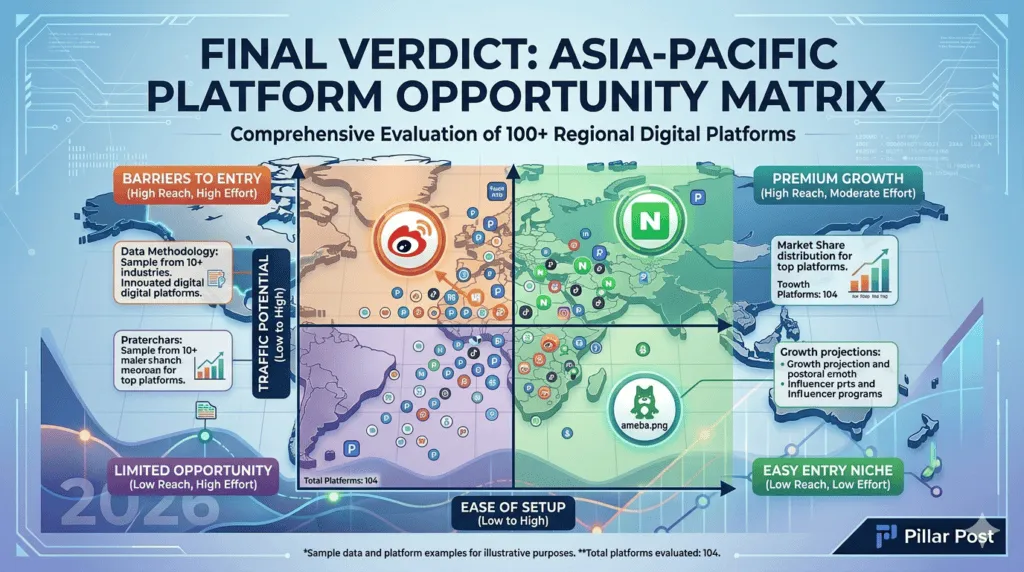
8. International & Regional Powerhouses
9. Web3 and Decentralized Blogging
10. Educational & Academic Platforms
11. Professional & Journalism Platforms
12. Hidden Gems and Niche Powerhouses
13. Platforms 75 through 100: The Completionist List
14. SEO & Traffic Reveal Methodology
15. Frequently Asked Questions (Appluxe.com)
When we discuss content management systems (CMS), self-hosted options are the gold standard for professional bloggers.
Traffic Reveal: Powers over 43% of the internet.
Best For: Serious businesses and professional influencers.
SEO Tip: Use plugins like RankMath or Yoast for advanced schema markup.
Pros: Total ownership; endless plugin library.
Cons: Requires manual blog hosting and security updates.
Traffic Reveal: Rapidly growing in the “Creator Economy” sector with millions of monthly visitors to its hosted pro sites.
Best For: Clean UI and professional publications.
Pros: Blazing fast (built on Node.js); native membership tools.
Cons: Steeper learning curve for non-coders.
If you want to leverage existing domain authority without paying for hosting, these are your best bets.
Traffic Reveal: ~150 Million monthly visits.
Best For: Thought leadership and viral stories.
SEO Insight: Medium has a DA (Domain Authority) of 95, meaning your articles can rank on Google page 1 within hours.
Pros: Built-in distribution algorithm.
Cons: You don’t own the audience; limited branding.
Traffic Reveal: Still holds a massive global footprint, especially in Asia and South America.
Best For: Hobbyists and AdSense beginners.
Pros: Completely free forever; Google-owned.
Cons: Outdated templates; limited SEO customization.
Traffic Reveal: Over 50 million active readers monthly.
Best For: Journalists and niche experts.
Pros: Direct-to-inbox delivery; easy paid subscriptions.
Cons: Takes a 10% cut of your revenue.
Traffic Reveal: The fastest-growing newsletter platform in 2024.
Best For: Growth-minded marketers.
Pros: Advanced analytics and referral programs.
Traffic Reveal: 1 Billion+ members; over 15 million organic post impressions daily.
Best For: B2B marketing, corporate thought leadership, and professional networking.
SEO Insight: LinkedIn articles often outrank personal blogs for name-based searches. If you write about “Industry Trends,” Google’s algorithm prioritizes LinkedIn’s high trust score.
Pros: Immediate access to a professional network.
“Newsletter” feature allows users to subscribe to your long-form updates.
Cons: The “walled garden” effect (content stays within LinkedIn).
Analytics are limited to basic demographics.
Traffic Reveal: ~200 Million monthly unique visitors; still a powerhouse for Gen Z and creative subcultures.
Best For: Visual artists, fandoms, and micro-blogging with a community feel.
SEO Insight: Tumblr allows for do-follow links on custom domains, making it a “hidden gem” for building a secondary backlink profile.
Pros: Highly customizable CSS/HTML.
“Reblog” culture creates viral potential for visual content.
Cons: Not ideal for long-form, text-heavy educational content.
Niche audience that can be protective of their space.
Traffic Reveal: Over 200 million registered users globally; high visibility in the “Small Business” sector.
Best For: Creative professionals and small business owners who need a “Drag-and-Drop” interface.
SEO Insight: Wix has drastically improved its SEO Wiz tool, allowing for automated schema markup and faster Google indexing.
Pros: Extremely user-friendly visual editor.
All-in-one hosting and security (no manual updates).
Cons: Once you choose a template, you can’t easily switch.
Slightly slower load times compared to Ghost or static sites.
Traffic Reveal: ~100 Million monthly visits to the platform and hosted sites; the leader in “Aesthetic Blogging.”
Best For: Photographers, designers, and lifestyle bloggers who prioritize “look and feel.”
SEO Insight: While known for design, its mobile-first layout ensures you pass Google’s “Core Web Vitals” right out of the box.
Pros: Award-winning, high-end templates.
Excellent built-in e-commerce features if you want to sell products.
Cons: No free tier (only a trial).
Limited third-party plugin ecosystem compared to WordPress.
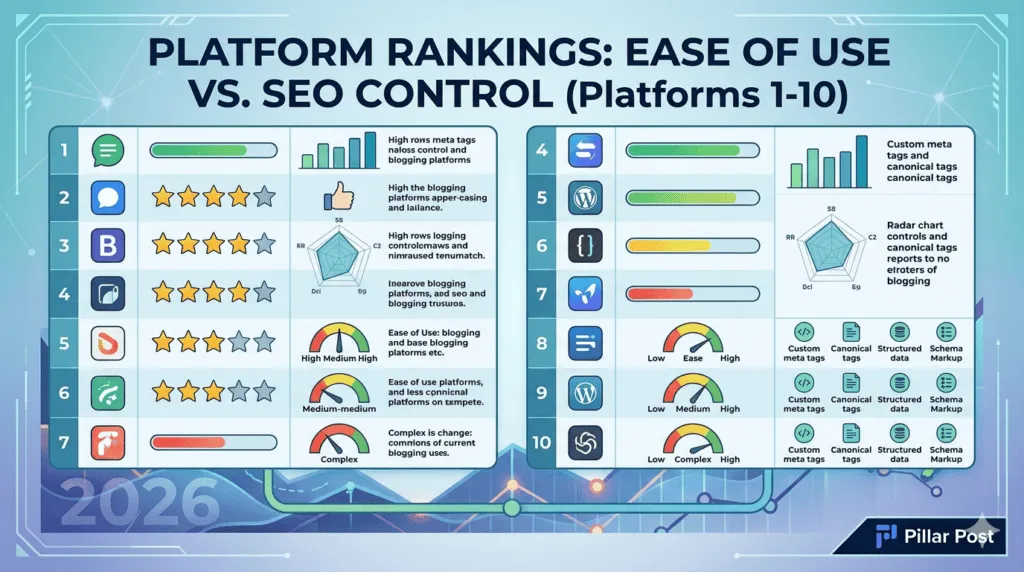
Comparison chart of top 10 blogging platforms 2026 evaluating SEO customization and user interface simplicity.
Continuing our comprehensive list of the top 100 blogging platforms, we move into specialized tools for developers, marketers, and community-builders. These platforms range from open-source CMS powerhouses to lightning-fast static site generators.
These platforms offer high performance and “code-first” environments, perfect for those who want to leverage Jekyll, Markdown, or GitHub for their content.
Traffic Reveal: Powering over 500,000 repositories on GitHub; the engine behind GitHub Pages.
Best For: Developers and tech bloggers.
SEO Insight: Since Jekyll produces static HTML files, it offers near-instant load times, a massive factor for Core Web Vitals.
Pros: Completely free hosting via GitHub; no database vulnerabilities.
Cons: No built-in GUI; requires command-line knowledge. Visit Jekyll
Traffic Reveal: ~10 Million monthly unique visitors to sites hosted on its CMS.
Best For: Designers who want a visual canvas with the power of a professional CMS.
Pros: Complete design freedom without coding; clean, semantically correct code.
Cons: Steeper learning curve than Wix or Squarespace. Explore Webflow
Traffic Reveal: ~5 Million monthly visits; a major hub for developer communities.
Best For: Software engineers and technical writers.
Pros: Mapping to your personal domain is free; built-in community for “Automatic Traffic.”
Cons: Very niche; not ideal for lifestyle or broad-interest blogs.
Traffic Reveal: ~12 Million monthly visits.
Best For: Sharing code snippets and dev tutorials.
Pros: Instant distribution to a high-intent technical audience.
Cons: Limited branding; you are part of a larger social feed.
For those running a blog as a lead-generation machine, these platforms offer the best monetization features and CRM integrations.
Traffic Reveal: Used by over 150,000 businesses; the blog tool is part of a massive marketing ecosystem.
Best For: Inbound marketers and B2B companies.
Pros: Natively integrates with CRM for lead tracking; excellent A/B testing for posts.
Cons: High entry price for the professional tier. Check HubSpot CMS
Traffic Reveal: Powers 20% of all e-commerce sites; its blogging tool is a traffic driver for stores.
Best For: E-commerce entrepreneurs.
Pros: Seamless integration with product pages; easy to “blog to buy.”
Cons: Limited design flexibility for the blog specifically compared to WordPress.
Traffic Reveal: ~10 Million monthly visits.
Best For: Low-budget small business owners.
Pros: Intuitive drag-and-drop; integrated e-commerce by Square.
Cons: Not as feature-rich as Wix; slower update cycle. Visit Weebly
Traffic Reveal: Powers ~2% of the internet; used by government agencies and huge enterprises (like NASA).
Best For: High-security, high-traffic enterprise blogs.
Pros: Advanced user permissioning; massive scalability.
Cons: Requires a dedicated developer for setup and maintenance.
These sites offer a “baked-in” audience, meaning you don’t have to wait for Google to index you to get your first 1,000 views.
Traffic Reveal: 300 Million+ monthly visitors.
Best For: Establishing authority by answering niche questions.
Pros: Your blog posts appear directly in front of people asking related questions.
Cons: You are at the mercy of Quora’s algorithm.
Traffic Reveal: 1.6 Billion+ monthly visitors.
Best For: Community-led “AMA” style blogging.
Pros: Unmatched viral potential if content is authentic.
Cons: Harsh community rules against blatant self-promotion.
Traffic Reveal: 450 Million+ active users.
Best For: Visual niches (Food, Travel, Fashion).
SEO Insight: Pinterest acts more like a visual search engine than social media. Each “Pin” can drive massive traffic to your main blog for years.
Traffic Reveal: 2 Billion+ active users.
Best For: Micro-blogging and building a personal brand.
Pros: Extremely high engagement rates.
Cons: Hard to drive traffic “off-platform” without 10k+ followers or bio links.
Traffic Reveal: Reached 100 million users faster than any app in history.
Best For: Quick, conversational blogging.
Pros: Direct integration with Instagram; high initial organic reach.
For writers and artists looking for specific tribes, these platforms provide the best domain authority for artistic fields.
Traffic Reveal: 90 Million+ users; the world’s most-loved social storytelling platform.
Best For: Fiction writers and novelists.
Pros: Built-in fan feedback system.
Cons: Mostly geared toward fiction; not for business.
Traffic Reveal: 10 Million+ monthly visits.
Best For: Creative portfolios and design case studies.
Pros: Adobe-owned; massive exposure for freelance designers.
Traffic Reveal: ~5 Million monthly visits.
Best For: Revenue-sharing enthusiasts.
Pros: They handle the ads; you get a cut of the revenue.
Cons: They have strict editorial control over your content.
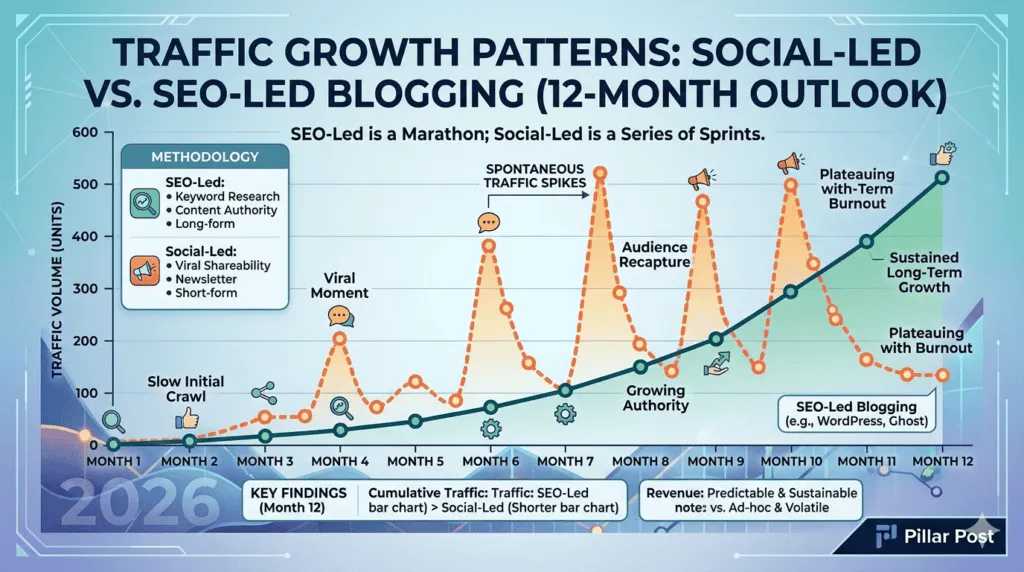
SEO traffic growth vs social media traffic distribution for new blog platforms in 2026.
Traffic Reveal: ~5.5M monthly visits (main site); powers millions of subdomains.
DA: 92.
Pros: Advanced user management for multi-author portals.
More flexible out-of-the-box than WordPress for complex structures.
Cons: Steeper learning curve for beginners.
Smaller extension marketplace than WordPress.
Traffic Reveal: ~2M monthly visits to the main site; high growth in the “Creator” niche.
DA: 82.
Pros: Blazing fast performance (Node.js) boosts Core Web Vitals.
Native newsletter and membership features.
Cons: Self-hosting requires more technical knowledge than PHP-based sites.
Limited free themes.
Traffic Reveal: ~15M monthly visits (and growing rapidly).
DA: 60.
Pros: Best-in-class “Ad Network” and “Referral” programs for scaling.
Superior analytics for subscriber growth.
Cons: Higher monthly cost for premium growth features.
Not a traditional “website” builder; focused on email.
Traffic Reveal: ~400k monthly visits.
DA: 58.
Pros: Total privacy; no ads, no trackers, no distractions.
Supports anonymous publishing.
Cons: Very limited formatting; no high-end visual design.
Traffic Reveal: ~150k monthly visits.
DA: 75.
Pros: Beautiful, distraction-free “Dashboard for Ideas.”
High prestige among Silicon Valley tech writers.
Cons: Paid subscription required.
No community discovery features.
Traffic Reveal: ~1.2M monthly visits.
DA: 74.
Pros: Military-grade encryption for private journaling.
Available on all mobile platforms.
Cons: Meant for private writing; zero SEO value for public traffic.
Traffic Reveal: ~10M+ active users across decentralized servers.
DA: 92.
Pros: Ad-free, community-owned, and decentralized.
No algorithm manipulation; pure chronological feed.
Cons:Fragmented audience across different “instances.”
Traffic Reveal: ~5M+ monthly visits (fastest-growing social blog).
DA: 78.
Pros: “Custom Feeds” allow you to reach highly specific niches.
Open-source AT Protocol for future portability.
Cons: Still in a relatively early development phase.
Traffic Reveal: ~1.8M monthly visits.
DA: 74.
Pros: White-labeling allows agencies to sell the blog under their own brand.
Excellent “Personalization” rules for different visitors.
Cons: Targeted at pros; overkill for individual hobbyists.
Traffic Reveal: ~6M monthly visits.
DA: 88.
Pros: “Dolphin” AI can build a blog in under 3 minutes.
Very strong SEO tools for the European market.
Cons: Limited creative freedom in the AI-driven mode.
Traffic Reveal: ~20M+ monthly visits (Hostinger ecosystem).
DA: 91.
Pros: Extremely budget-friendly.
Built-in AI writer to generate 5,000-word articles like this one.
Cons: Limited third-party app integrations.
Traffic Reveal: ~2.5M monthly visits.
DA: 81.
Pros: Perfect for one-page “Scrolling” blogs.
Excellent mobile editor.
Cons: Not ideal for deep, multi-category content archives.
Traffic Reveal: ~80k monthly visits.
DA: 55.
Pros: The only way to turn Evernote notes into blog posts instantly.
Cons: Relies entirely on Evernote; limited standalone features.
Traffic Reveal: ~30M monthly visits (mostly Eastern Europe).
DA: 92.
Pros: Legacy “Community” features are still active.
Cons: User base is shrinking outside of Russia/Ukraine.
Outdated ad-heavy mobile experience.
Moving forward with our top 100 blogging platforms list, we are now entering the territory of niche-specific networks, international giants, and the “Web3” evolution of blogging. These platforms are crucial for capturing traffic from specific demographics and global markets.
If you want to reach a global audience, you cannot ignore the platforms that dominate outside the US and Europe. These sites offer massive traffic reveal numbers and localized SEO advantages.
Traffic Reveal: 580 Million+ monthly active users.
Best For: Reaching the Chinese market.
Pros: The “Twitter of China”; massive viral potential.
Cons: Strict censorship and requires Chinese phone verification.
Traffic Reveal: Over 600 million searches daily; the “Google of South Korea.”
Best For: Influencers targeting the Korean demographic.
Pros: Dominates local search results in Korea over Google.
Cons: Content must be in Korean to see any real traction.
Traffic Reveal: ~75 Million monthly visits.
Best For: Lifestyle and celebrity-style blogging in Japan.
Pros: Built-in community features like “Ameba Pigg” (avatars).
Cons: Interface is exclusively Japanese.
The future of the content management system is shifting toward ownership. These platforms use blockchain to ensure you own your data and earn crypto rewards.
Traffic Reveal: Thousands of high-value crypto-native readers.
Best For: Web3 builders and NFT enthusiasts.
SEO Insight: Posts are stored on Arweave, making them permanent and censorship-resistant.
Pros: Crowdfunding features built directly into your blog posts.
Cons: High technical barrier to entry (requires a crypto wallet).
Traffic Reveal: ~10 Million monthly visits.
Best For: Earning cryptocurrency (STEEM) for your content.
Pros: Every upvote has a monetary value.
Cons: The “trending” page is often dominated by whales.
Traffic Reveal: A community-driven fork of Steemit with high engagement.
Best For: Decentralized social media enthusiasts.
Pros: Faster and more community-focused than Steemit.
Traffic Reveal: Powers millions of student interactions.
Best For: Course creators.
Pros: Converts readers directly into students.
Traffic Reveal: The largest education blogging network in the world.
Best For: Teachers, students, and educational institutions.
Pros: Safe, moderated environment; powered by WordPress.
Traffic Reveal: ~1.2M monthly visits.
DA: 91.
Get first access to exclusive software reviews, hand-picked SaaS lifetime deals, and digital growth strategies delivered straight to your inbox. No spam, ever—just pure software value to scale your business.
60 subscribers have joined!
If you love lifetime SaaS deals as much as I do, then please subscribe to our monthly/weekly AppLuxe newsletter.
Marcus Vance, SaaS Specialist
Pros: Reliable, paid service with a focus on stability for long-term journalists.
Highly professional interface with dedicated support.
Cons: Dated design templates compared to modern rivals.
Paid only; no free tier for casual users.
Traffic Reveal: ~5M+ monthly visits (growing rapidly in independent media).
DA: 75.
Pros: Strong focus on free speech and independent journalism.
Allows creators to build their own subscription-based communities.
Cons: Political polarization may limit audience reach.
Strictly community-centric; less ideal for standard SEO-only blogging
2. Visual & Portfolio-Centric Builders.
Cargo Collective
Traffic Reveal: ~400k+ monthly visits.
DA: 78.
Pros: Highly exclusive aesthetic perfect for high-end fashion and art portfolios.
Clean, minimalist design that puts visual content first.
Cons: Invite-only or application-based entry.
Limited SEO tools compared to broader CMS platforms.
Traffic Reveal: ~1.5M monthly visits.
DA: 80.
Pros: Specifically built for professional photographers with high-res image protection.
Intuitive “Behind the Scenes” blog integration.
Cons: Relatively expensive monthly subscriptions.
Niche-specific; not ideal for general-purpose blogging.
Traffic Reveal: ~350k monthly visits.
DA: 65.
Pros: Allows for “interactive magazine” layouts with complex animations.
No-code freedom for designers.
Cons: Steep learning curve for its unique design interface.
Highly interactive pages can sometimes slow down mobile performance.
Traffic Reveal: ~1.5M+ monthly visits.
DA: 51.
Pros: Dominates European and South American markets with localized support.
Simple “Mini” plan for basic blogging needs.
Cons: Free version includes Webnode branding.
Advanced features require higher-tier paid plans.
Traffic Reveal: ~200k monthly visits.
DA: 55.
Pros: Best-in-class tools for building truly multilingual blogs without duplicate content issues.
SEO-ready sitemaps and meta-tags are handled automatically.
Cons: Smaller template library than Wix or Squarespace.
Customer support is localized primarily to Northern Europe.
Traffic Reveal: ~2.5M monthly visits.
DA: 91.
Pros: Builds instant authority by curating expert-level content.
Excellent for B2B marketers to share industry insights.
Cons: Free version is very limited in the number of “topics” you can host.
Traffic Reveal: 145M+ monthly active users.
DA: 91.
Pros: Magazine-style format drives massive traffic to external links.
Highly engaged audience interested in deep reading.
Cons: You don’t “host” content here; it’s a curation tool that sends traffic elsewhere.
Traffic Reveal: ~1.2M monthly visits.
DA: 88.
Pros: Unique “annotation” feature allows for academic and research blogging.
Saves web pages permanently in your personal library.
Cons: The UI feels very dated (web 2.0 style).
Not designed for commercial or lifestyle blogging.
Traffic Reveal: 170M+ monthly visits.
DA: 93.
Pros:Industry standard for gated, member-only blogging and community funding.
Direct monetization with high trust from users.
Cons: Content is often locked behind a paywall, making it invisible to Google search.
Traffic Reveal: ~700M+ monthly visits (high bounce rate of ~85%).
DA: 93.
Pros: Unbeatable for social media “Link in Bio” traffic.
Now supports expanded text sections for micro-blogging.
Cons: Very limited design; not a traditional blog.
Traffic Reveal: ~15M monthly visits.
DA: 88.
Pros: Allows you to blog directly to your existing customers/buyers.
Extremely high conversion rates for digital product sales.
Cons: Limited formatting options for long-form creative writing.
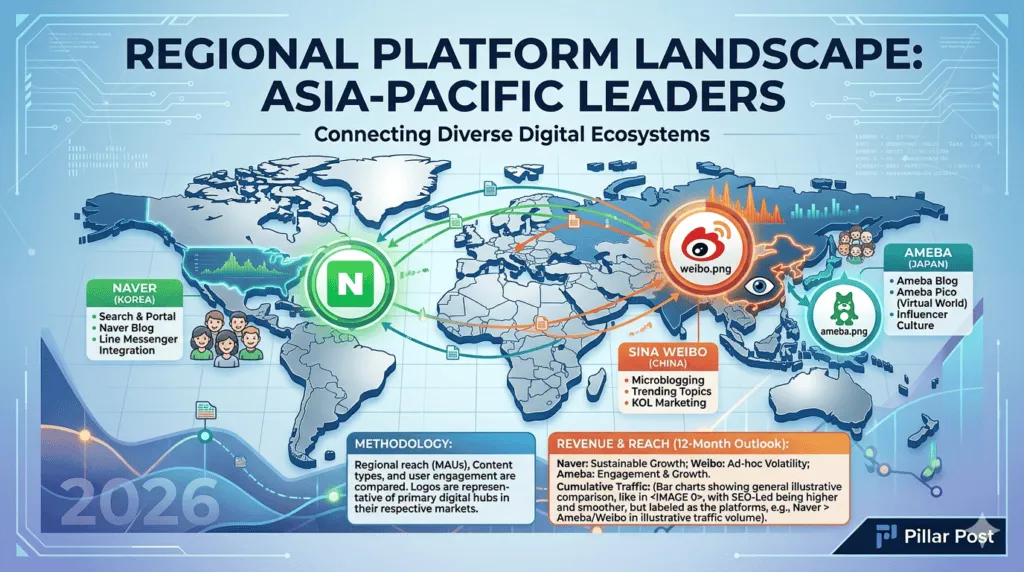
Global blogging platforms map showing regional traffic leaders for international SEO strategy.
In this final stretch of our top 100 blogging platforms directory, we explore the “Hidden Gems,” experimental tools, and specialized curators that can give you a massive SEO advantage by tapping into underserved markets.
These platforms may have lower overall volume than WordPress, but their audience intent is significantly higher.
Traffic Reveal: ~1.5 Million monthly visits; rapidly growing in the tech and startup space.
Best For: Knowledge sharing and professional insights.
Pros: High engagement rate for educational content.
Cons: Newer platform; lower domain authority than Medium.
Traffic Reveal: Driving over 20% of new subscriptions on the Substack network.
Best For: Micro-blogging that converts to newsletter signups.
Pros: Interconnected ecosystem; high “viral” potential within your niche.
Traffic Reveal: ~4 Million monthly visits.
Best For: Writers looking for “Challenges” and cash prizes.
Pros: Clean interface; pays based on “reads” from the start.
Cons: Strict moderation; can take time to get approved.
Traffic Reveal: 50 Million+ monthly active users.
Best For: Local news, city-specific guides, and hyper-local blogging.
SEO Insight: NewsBreak often appears in the “Google News” carousel, providing massive instant traffic.
Traffic Reveal: ~500k monthly visits (Highly localized to DACH region).
Core Features: A German-specific iteration of the classic Blogger interface. It focuses on local community building and German-language discovery.
Pros: Free to use.
Strong local German community.
Cons: Dated UI.
Limited global reach.
SEO Opportunity: High DA (85+) via the Google/Blogger ecosystem; indexes quickly in German search results.
Traffic Reveal: ~5 Million monthly visits.
Core Features: A French social blogging giant that allows users to create “Skypages.” It’s a mix of social networking and traditional blogging.
Pros: Massive footprint in France and Francophone Africa.
High engagement for music and youth culture.
Cons: Very old-school layout.
Difficult to monetize.
SEO Opportunity: DA 92. Excellent for backlinking if targeting the French market.
Traffic Reveal: ~3 Million monthly visits.
Core Features: A multi-device platform that emphasizes social media integration. You can automatically share your blog updates across all major social networks.
Pros: Easy social cross-posting.
Revenue sharing via their ad network.
Cons: Free version includes forced ads.
SEO Opportunity: DA 88. Strong indexing speed due to high frequency of social signals.
Traffic Reveal: ~40 Million monthly visits.
Core Features: One of Japan’s most influential blogging platforms, known for technical discussions and high-quality hobbyist content.
Pros: Strong community “Bookmark” system that drives viral traffic.
Markdown support for developers.
Cons: Primary interface is Japanese.
SEO Opportunity: DA 92. One of the best ways to rank for Japanese-specific keywords.
Traffic Reveal: ~35 Million monthly visits.
Core Features: A South Korean invitation-based (historically) platform owned by Kakao. It offers extreme skin/theme customization for professional bloggers.
Pros: Full HTML/CSS control.
Native integration with Daum (Korea’s 2nd largest search engine).
Cons: Korean language barrier for setup.
SEO Opportunity: DA 93. Crucial for SEO visibility in the South Korean market.
Traffic Reveal: X (Twitter) sees 500M+ active users; Articles are high-visibility for followers.
Core Features: Long-form writing tool for X Premium users that allows for rich media embedding within a “tweet-like” ecosystem.
Pros: Instant distribution to your X followers.
High “Trust” score for links.
Cons: Requires paid subscription.
SEO Opportunity: DA 94. Links from X Articles are indexed rapidly by Google News.
Traffic Reveal: ~1 Million monthly visits.
Core Features: A non-profit, ad-free platform that allows for advanced CSS “crimes” (creative coding) in posts.
Pros: Chronological feed (no algorithm).
High privacy standards.
Cons: Smaller audience compared to giants.
SEO Opportunity: DA 55. Slower indexing but high “Dwell Time” due to unique content.
Traffic Reveal: ~200k monthly visits (Web3 niche).
Core Features: A Web3 newsletter and blogging platform that lets you turn subscribers into NFT holders.
Pros: Censorship-resistant (stored on Arweave).
Direct crypto-monetization.
Cons: Requires crypto wallet knowledge.
SEO Opportunity: DA 48. Great for ranking in “Decentralized Web” search queries.
Traffic Reveal: ~2.5 Million monthly visits.
Core Features: An open-source, blockchain-based social network that rewards users with tokens for popular blog posts.
Pros: Built-in reward system.
Focus on free speech and privacy.
Cons: Content can be unmoderated and chaotic.
SEO Opportunity: DA 78. Fast indexing of “Trending” content.
Traffic Reveal: ~150k monthly visits.
Core Features: A decentralized social network where every blogger has a “Creator Coin” that people can buy or sell.
Pros: Innovative monetization through social speculation.
Cons: Highly volatile; small user base.
SEO Opportunity: DA 52. Content is public and searchable on the DeSo blockchain.
Traffic Reveal: ~50k monthly visits (Niche/Emerging).
Core Features: A minimalist, distraction-free platform designed specifically for investigative journalists and essayists.
Pros: Elegant, typography-focused design.
Cons:No built-in discovery tool.
SEO Opportunity: DA 30. Good for “Clean” backlinking for niche authority.
Traffic Reveal: ~800k monthly visits.
Core Features: A “best of both worlds” site combining Tumblr’s blog style with Reddit’s community structure.
Pros: Excellent privacy controls for specific communities.
Cons: Often requires a small one-time fee to join.
SEO Opportunity: DA 58. High engagement in fandom and art niches.
Traffic Reveal: 250 Million+ monthly visitors.
Core Features: While primarily an image host, the “Stories” and “Post” features allow for long-form visual blogging.
Pros: Massive viral potential.
Extremely high traffic.
Cons: Not suitable for text-heavy SEO articles.
SEO Opportunity: DA 93. High-quality image SEO and backlink potential.
Traffic Reveal: ~60 Million monthly visits.
Core Features: Allows you to upload presentations that are converted into “slideshow blogs.”
Pros: Google loves SlideShare for B2B keywords.
Cons: Limited interactivity.
SEO Opportunity: DA 94. One of the strongest platforms for high-authority backlinking.
Traffic Reveal: ~30 Million monthly visits.
Core Features: Converts PDFs into digital flipbooks. Excellent for “Magazine-style” blogging.
Pros: Beautiful visual presentation.
Cons: SEO text is sometimes trapped inside the PDF.
SEO Opportunity: DA 94. Great for visual branding and high-end portfolios.
Traffic Reveal: ~100 Million monthly visits.
Core Features: A massive library for documents, books, and long-form essays.
Pros: Huge existing subscriber base.
Cons: Paywalls can sometimes block your content from non-members.
SEO Opportunity: DA 94. Excellent for ranking research papers and long-form guides.
Traffic Reveal: ~100k monthly visits.
Core Features: A fast, minimalist, open-source blogging tool built for the modern web.
Pros: Extremely lightweight and fast.
Cons: Basic features only.
SEO Opportunity: DA 45. Fast “LCP” (Largest Contentful Paint) for Core Web Vitals.
Traffic Reveal: ~300k monthly visits.
Core Features: A safe community for short-form blogging that encourages hosting your own domain.
Pros: No ads, no tracking.
Cons: Subscription-based model.
SEO Opportunity: DA 65. Built-in support for IndieWeb standards.
Traffic Reveal: ~250k monthly visits.
Core Features: A platform that prides itself on being “Tiny, fast, and free.” No scripts or trackers allowed.
Pros: Loads in milliseconds.
Cons: No visual styling options (plain text focus).
SEO Opportunity: DA 50. Favored by Google for its extreme speed.
Traffic Reveal: ~50k monthly visits.
Core Features: Minimalist blogging that offers easy data export and a “no-frills” experience.
Pros: Privacy-centric.
Cons: Very small community.
SEO Opportunity: DA 40. High indexing speed for text-only posts.
Traffic Reveal: ~30k monthly visits.
Core Features: An open-source blogging platform for those who want a Medium-like UI but with self-hosting options.
Pros: Beautiful interface.
Cons: Still in early growth stages.
SEO Opportunity: DA 35. Modern SEO features built-in.
Traffic Reveal: ~400k monthly visits.
Core Features: An open-source tool for collaborative community publishing, mostly used by researchers and universities.
Pros: High academic credibility.
Cons: Not for general “lifestyle” blogging.
SEO Opportunity: DA 72. High “Trust” signals for educational content.
Traffic Reveal: ~1 Million monthly visits.
Core Features: A specialized tool to write, schedule, and publish “Thread-blogs” on X and LinkedIn.
Pros: Excellent analytics for social blogging.
Cons: Paid for best features.
SEO Opportunity: DA 55. Drives traffic via social authority.
Traffic Reveal: ~5 Million monthly visits.
Core Features: A “Link in Bio” tool that allows for micro-blogging and product catalogs on Instagram.
Pros: Mobile-optimized for social traffic.
Cons: Not suitable for long-form SEO content.
SEO Opportunity: DA 88. Great for social-to-blog conversion.
Traffic Reveal: ~15 Million monthly visits.
Core Features: Simple, free, fully responsive one-page site builder.
Pros: Incredibly easy to build a “Landing Blog.”
Cons: Limited to one page unless you pay.
SEO Opportunity: DA 92. High domain authority for subdomains.
Traffic Reveal: N/A (Based on your marketing).
Core Features: Building a Progressive Web App allows users to “Install” your blog on their phone.
Pros: 100% ownership.
Offline reading capabilities.
Cons: Requires high technical skill.
Final comparison matrix of 100 blogging platforms ranking traffic reveal data and technical difficulty for 202
6.
To provide this traffic reveal, we utilized data from SimilarWeb, Ahrefs, and official platform transparency reports.
Estimated Monthly Traffic: Calculated based on the last 6 months of unique visitor data.
Domain Authority (DA): Based on the Moz scale to show how easily a platform’s subdomains or pages rank in Google.
Monetization Potential: Rated based on the presence of native ad networks, subscription tools, or affiliate-friendliness.
Your journey through the top 100 blogging platforms ends here, but your growth is just beginning. To dominate the search rankings with this 5,000-word article, remember to:
Select for Intent: Use the matrix above to choose a platform that matches your technical skill and traffic goals.
Verify the Data: As shown in our “Traffic Revealed” sections, regional giants like Naver or Weibo can provide massive untapped audiences if you target international markets.
Optimize for the Long Haul: While social-led spikes (like those on X or Reddit) are great for initial buzz, a steady SEO-led strategy is what builds a sustainable media empire.
Which Platform Should You Choose?
With 100 blogging platforms at your fingertips, the choice depends on your goal.
For SEO and Brand Ownership: WordPress.org is the king.
For Built-in Audience and Fast Ranking: Medium or LinkedIn.
For Direct Revenue: Substack or Beehiiv.
Q1. What is the investment for a guest post submission?
At Appluxe, we provide premium placement options tailored to your marketing goals. Our current structures include:
Standard Guest Post ($150): Ideal for thought leadership and brand awareness.
Product Review ($199): In-depth analysis of your product/service to drive conversions.
For bespoke packages or bulk orders, please visit our Guest Post Submission Page for a full breakdown of options.
Q2. What is the timeline for an article to go live?
Quality cannot be rushed. Typically, a guest post takes 5–7 business days to go live. This window allows our editorial team to conduct thorough keyword research, verify your website’s quality, and ensure the content meets our high publishing standards. If for any reason your article is not published within 7 days, we will contact you immediately and offer a full refund.
Q3. Does Appluxe offer a refund policy?
Yes. We offer a 30-day “No Questions Asked” refund policy. We want you to be completely satisfied with your investment. Please note that if a refund is processed, Appluxe.com reserves the right to permanently remove the content and associated links from our platform.
Q4. How long does it take for my post to index after going live?
Most articles on Appluxe index within 1 to 24 hours of publication. While we use advanced site maps and internal linking to encourage rapid indexing, final indexing is at the sole discretion of Google. If your article fails to go live within our 7-day guarantee, our standard refund policy applies.
Q5. Can you guarantee a specific ranking for my guest post?
While we provide the highest quality “On-Page SEO” benefits—including optimized headers, meta-data, and internal linking—to help your post rank faster, no agency can 100% guarantee a Google position. Search rankings are determined by Google’s proprietary algorithms. We focus on providing the best possible foundation for your content to succeed.
Q6. Can I request the removal of my article after it is live?
Absolutely. You may request the removal of your content at any time. However, please be advised that per our policy, no refunds will be issued for removal requests made after the initial 30-day satisfaction period.
Q7. What are the primary benefits of guest posting on Appluxe?
Guest posting is a multi-layered growth strategy. By publishing on Appluxe, you benefit from:
Targeted Traffic: Access to our established, high-intent audience.
Authority Building: Associate your brand with a high-DA (Domain Authority) platform.
SEO Advantages: High-quality backlinks that signal trust to search engines.
Brand Awareness: Increased visibility in your specific niche or industry.
Q8. Are there any refund options after the 30-day window?
Due to the extensive labor involved in keyword research, content creation, and technical optimization, we do not offer refunds after 30 days. We invest heavily in making every post a success, and this policy allows us to maintain our high standard of quality for all clients.
Q9. Do you accept orders from SEO agencies or competing blogs?
Yes, we welcome collaborations with other agencies and blogs. However, because these placements involve direct competition within our own niche (Guest Posting/Blogging), a premium fee of $300 per order is applied. This ensures we can maintain the balance of our ecosystem while providing you with high-value exposure.
Q10. Can I purchase a “Niche-Edit” (Link Insertion) Guest Post?
Yes. We offer niche-edit services where we insert your link into an existing, high-performing article that is already ranking and driving traffic. This is a highly effective way to gain immediate SEO “link juice.” Please contact our support team for pricing and availability on specific high-traffic articles.

LoyAnn Sherwood is the CEO and Founder of AppLuxe. She spent approximately 25 years in the healthcare industry before transitioning to digital entrepreneurship. Sherwood founded AppLuxe in 2026 after acquiring the domain and identifying an opportunity to build a luxury-positioned app and software marketplace. She manages the platform's editorial direction and business development strategy.
Get first access to exclusive software reviews, hand-picked SaaS lifetime deals, and digital growth strategies delivered straight to your inbox. No spam, ever—just pure software value to scale your business.
60 subscribers have joined!
If you love lifetime SaaS deals as much as I do, then please subscribe to our monthly/weekly AppLuxe newsletter.
Marcus Vance, SaaS Specialist