Discover expert articles on AI, SaaS, software, marketing, SEO, affiliate marketing and startup growth.
Discover expert articles on AI, SaaS, software, marketing, SEO, affiliate marketing and startup growth.
By LoyAnn Sherwood
Published on Apr 15, 2026
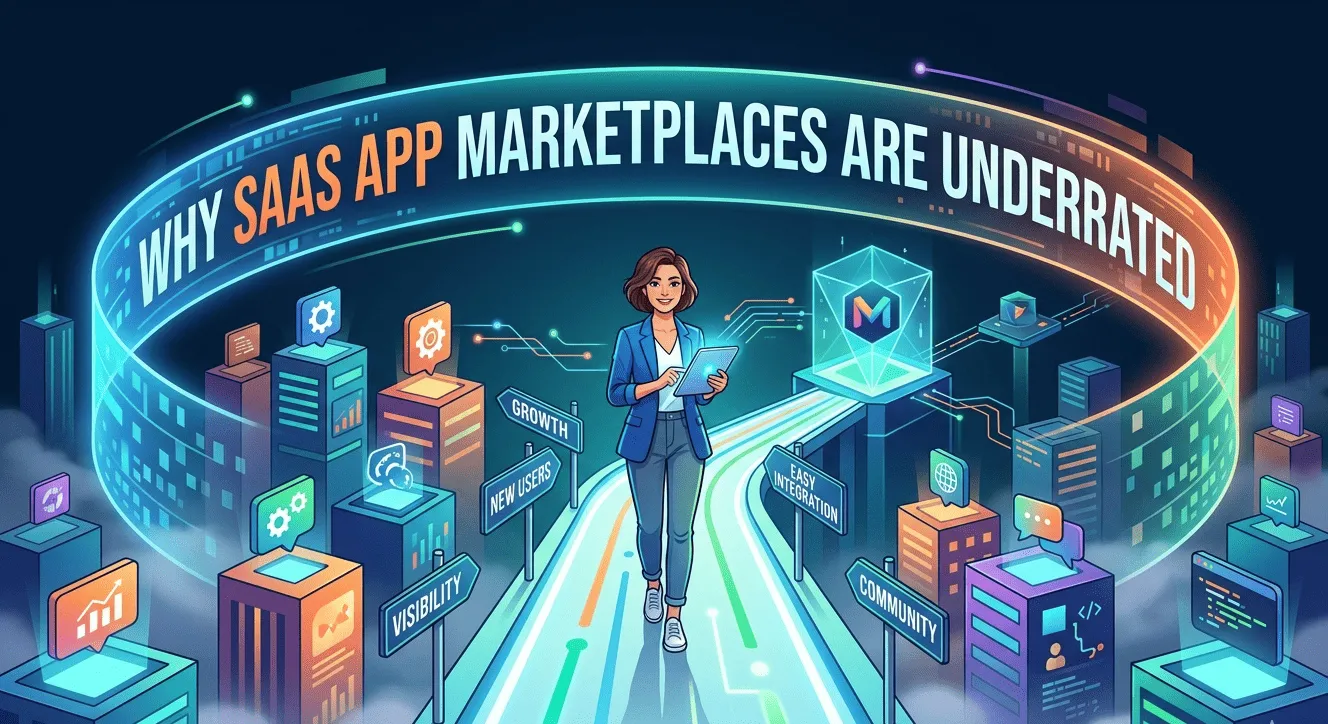
If you spend any time in startup circles, you’ll hear the same playbook repeated over and over: build a SaaS product, scale with subscriptions, chase recurring revenue, and eventually exit. What you don’t hear nearly as often is the quiet, almost overlooked opportunity sitting right next to that model—SaaS app marketplaces.
That’s surprising, because marketplaces have quietly powered some of the biggest success stories in tech. Yet when it comes to SaaS, founders tend to think in terms of single products, not ecosystems. And that’s exactly why SaaS app marketplaces remain underrated—they’re misunderstood, underbuilt, and often dismissed as “too complex” or “not for beginners.”
The truth? They’re one of the most powerful business models available today—if you understand how to approach them.
Let’s break down why SaaS app marketplaces deserve way more attention than they currently get.
To explore real tools and platforms in this space, check out our Apps & Software section.
The biggest reason SaaS marketplaces are underrated is simple: people think they’re too hard to build.
There’s a common belief that marketplaces require:
That belief isn’t entirely wrong—but it’s outdated.
Today, no-code and low-code tools have changed the equation completely. You can now build a functioning marketplace in days, not months. Payment systems, onboarding flows, user dashboards, and integrations are easier than ever to set up.
But the perception hasn’t caught up with reality.
Most founders still think:
“I’ll just build a SaaS tool—it’s simpler.”
And that’s exactly why marketplaces remain underutilized. While everyone crowds into single-product SaaS niches, marketplaces sit wide open.
If you’re exploring modern tools and platforms, you can also browse our AI Tools category.
To understand why marketplaces are underrated, you have to understand how different they are from traditional SaaS.
A typical SaaS product:
A SaaS marketplace:
That last point is critical.
In SaaS, growth depends on how many customers you can acquire.
In marketplaces, growth depends on how many connections you can create.
That’s a completely different game—and a much more powerful one
For more business models and strategies, explore our Business category.
One of the biggest reasons SaaS marketplaces are underrated is that people underestimate network effects.
Here’s how it works:
This loop creates a self-reinforcing system.
Traditional SaaS doesn’t have this advantage. You’re constantly pushing uphill—spending on ads, optimizing funnels, fighting churn.
Marketplaces, on the other hand, can eventually grow on their own momentum.
Once you hit a certain threshold, the platform starts working for you.
That’s not just growth—that’s leverage.
Learn more about scalable systems in our Technology section.
Another reason SaaS marketplaces are underrated: they don’t rely on a single income stream.
A standard SaaS app usually makes money through:
That’s it.
A marketplace, however, can monetize in multiple ways:
You’re not just selling a product—you’re monetizing an ecosystem.
That means:
And yet, most founders still chase single-stream SaaS models.
You can also explore monetization strategies in our Make Money Online section.
Here’s something that doesn’t get talked about enough: SaaS marketplaces actually reduce product risk.
When you build a SaaS tool, everything depends on one idea.
If that idea fails:
In a marketplace, you’re not betting on one solution.
You’re hosting many solutions.
If one vendor fails, another replaces them. If one category underperforms, another can grow.
You’re not tied to a single outcome—you’re building a platform that adapts.
That’s a massive strategic advantage.
Launching a SaaS product often takes months of development before you even know if people want it.
Marketplaces flip that process.
Instead of building a full product, you:
You’re validating demand in real time.
You don’t need to guess what users want—you can observe:
This creates a feedback loop that’s far more powerful than traditional product validation.
One of the biggest reasons SaaS marketplaces are underrated is simply because people haven’t explored the possibilities.
Everyone is building:
But very few are building marketplaces for:
Think about this:
Every industry has tools, services, and experts.
Very few have centralized marketplaces.
That’s the opportunity.
Examples of underserved marketplace niches:
The more niche you go, the less competition you face.
For more niche tools and platforms, visit our Apps & Software category.
Distribution is the hardest part of any SaaS business.
You can build the best product in the world—but if no one sees it, it doesn’t matter.
Marketplaces solve this differently.
Instead of you doing all the marketing:
Every participant becomes a growth channel.
This creates a compounding effect:
Traditional SaaS doesn’t benefit from this kind of built-in distribution.
Discover more growth strategies in our Business insights.
Investors and acquirers love marketplaces.
Why?
Because they’re harder to replicate.
A SaaS tool can be cloned.
A marketplace with:
…is much harder to copy.
That makes marketplaces more defensible—and often more valuable in the long run.
SaaS marketplaces are especially underrated right now because of timing.
We’re at a unique intersection of:
This creates the perfect environment for marketplaces to thrive.
Five years ago, building a marketplace required serious engineering.
Today, it’s accessible to solo founders.
That shift hasn’t fully sunk in yet—which means early adopters have a major advantage.
Get first access to exclusive software reviews, hand-picked SaaS lifetime deals, and digital growth strategies delivered straight to your inbox. No spam, ever—just pure software value to scale your business.
60 subscribers have joined!
If you love lifetime SaaS deals as much as I do, then please subscribe to our monthly/weekly AppLuxe newsletter.
Marcus Vance, SaaS Specialist
Beyond technical challenges, there’s a psychological reason SaaS marketplaces are underrated.
They feel:
Founders like control.
A SaaS product feels clean:
A marketplace involves:
That uncertainty scares people off.
But that same complexity is what creates opportunity.
Another misconception is that marketplaces need to launch with massive scale.
They don’t.
The best marketplaces start small:
Then they expand.
You don’t need thousands of vendors.
You need:
Start focused, then grow outward.
In traditional SaaS, you’re responsible for:
In a marketplace, you’re enabling others to create value.
That’s leverage.
You’re not doing all the work—you’re creating the system where work happens.
This allows you to:
It’s a fundamentally different way to build a business.
To be fair, SaaS marketplaces do have challenges:
But here’s the key:
These challenges are barriers to entry.
They keep competition low.
Most people avoid marketplaces because they’re harder.
That’s exactly why they’re valuable.
The biggest companies in SaaS aren’t just products anymore—they’re ecosystems.
Think about how modern platforms operate:
That’s essentially a marketplace model layered on top of SaaS.
The future isn’t just building tools.
It’s building platforms where tools live.
Explore SaaS tools and integrations in our SaaS category.
The Rule of 40 is a benchmark used to measure the overall health of a SaaS company. It states that a company’s growth rate (%) + profit margin (%) should equal or exceed 40%.
For example:
The idea is simple:
Investors use this rule to quickly evaluate whether a SaaS business is scaling efficiently without burning too much cash.
Many SaaS companies are facing pressure today due to a combination of market and structural challenges:
1. Rising customer acquisition costs (CAC)
Paid ads are more expensive, and competition is intense.
2. Market saturation
Almost every niche now has multiple SaaS tools competing for the same audience.
3. Churn issues
Users cancel subscriptions quickly if they don’t see immediate value.
4. Economic tightening
Businesses are cutting software expenses and consolidating tools.
5. Over-reliance on one product
If a single product fails to evolve, growth stalls.
6. AI disruption
Some traditional SaaS features are being replaced by AI-powered tools.
These factors are pushing SaaS companies to rethink their models—many are now moving toward ecosystems, integrations, or marketplace strategies to stay competitive.
Marketplaces are generally categorized based on who is buying and selling:
1. B2C (Business-to-Consumer)
Businesses sell directly to consumers.
Example: eCommerce platforms.
2. B2B (Business-to-Business)
Businesses sell to other businesses.
Example: SaaS app marketplaces or wholesale platforms.
3. C2C (Consumer-to-Consumer)
Individuals sell to other individuals.
Example: peer-to-peer platforms.
4. C2B (Consumer-to-Business)
Individuals offer products or services to businesses.
Example: freelance or creator marketplaces.
Each type has different dynamics, but all rely on connecting supply and demand efficiently.
No—AI is not replacing SaaS, but it is transforming it.
Here’s what’s actually happening:
1. SaaS is evolving into AI-powered SaaS
Most modern tools are integrating AI instead of being replaced by it.
2. Standalone tools are at risk
Simple SaaS apps with limited features may be replaced by AI platforms that do multiple tasks.
3. Platforms will win over single tools
Ecosystems and marketplaces will become more valuable than isolated products.
4. AI increases expectations
Users now expect automation, personalization, and faster results.
In short:
The real shift isn’t SaaS vs AI—it’s SaaS + AI + marketplaces working together.
For more SaaS and platform insights, check out our Technology and AI Tools sections.
SaaS app marketplaces are underrated because they sit in an uncomfortable middle ground.
They’re not as simple as a single-product SaaS.
They’re not as widely understood as traditional marketplaces.
But that’s exactly where the opportunity lies.
They offer:
While most founders chase crowded SaaS ideas, marketplaces remain relatively open territory.
The barrier isn’t technology anymore.
It’s mindset.
And the founders who recognize that shift early will have a serious edge in the years ahead.
Want to explore more tools, platforms, and strategies? Browse our Apps & Software and Business categories.
[rafflepress id=”1″]


LoyAnn Sherwood is the CEO and Founder of AppLuxe. She spent approximately 25 years in the healthcare industry before transitioning to digital entrepreneurship. Sherwood founded AppLuxe in 2026 after acquiring the domain and identifying an opportunity to build a luxury-positioned app and software marketplace. She manages the platform's editorial direction and business development strategy.
Get first access to exclusive software reviews, hand-picked SaaS lifetime deals, and digital growth strategies delivered straight to your inbox. No spam, ever—just pure software value to scale your business.
60 subscribers have joined!
If you love lifetime SaaS deals as much as I do, then please subscribe to our monthly/weekly AppLuxe newsletter.
Marcus Vance, SaaS Specialist