Discover expert articles on AI, SaaS, software, marketing, SEO, affiliate marketing and startup growth.
Discover expert articles on AI, SaaS, software, marketing, SEO, affiliate marketing and startup growth.
By LoyAnn Sherwood
Published on Apr 9, 2026
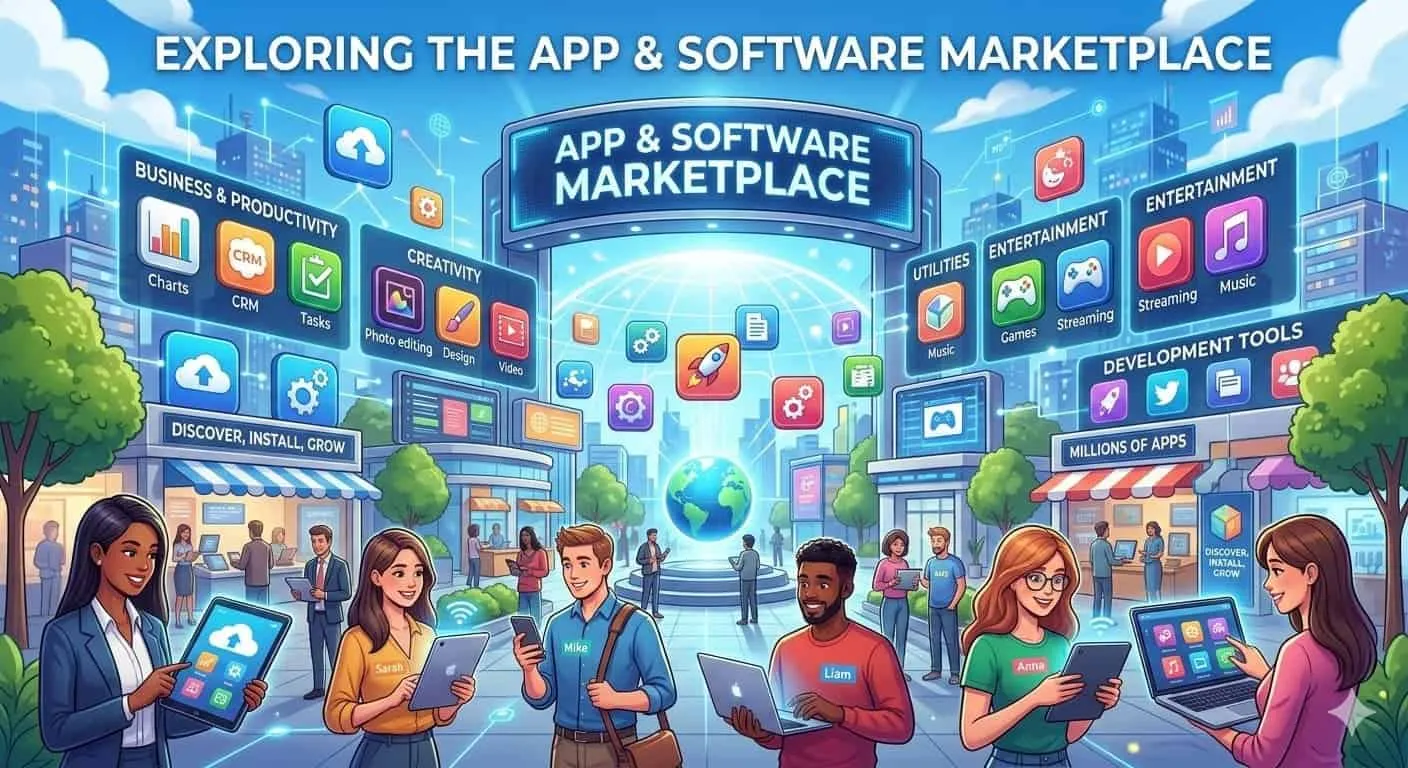
If you’ve downloaded an app to track your workouts, added a shipping plugin to your online store, or connected a payment tool to your CRM, you’ve used an app and software marketplace.
You probably didn’t think twice about it.
But behind that simple “Install” button is one of the most important business models of the last 20 years.
An app & software marketplace isn’t just a download hub. It’s a structured digital ecosystem where software is discovered, evaluated, purchased, and managed—all in one place. It’s the reason startups can reach global users overnight and why businesses can build powerful tech stacks without hiring massive development teams.
To explore real examples of platforms like these, check out our Apps & Software section.
Behind every marketplace, there are three moving parts:
This is the individual or company building the software. It might be a mobile game, an accounting integration, or a cybersecurity tool.
This is the company that operates the platform, sets the rules, reviews submissions, handles billing, and takes a percentage of revenue.
The person or business searching for a solution.
Here’s the flow:
That’s the entire machine.
Simple on the surface. Highly strategic underneath.
If you’re interested in how digital platforms scale, explore our Business category for more insights.
Most people associate marketplaces with phone apps. That’s only one category.
Let’s look at the bigger picture.
Mobile App Marketplaces
These are consumer-focused platforms designed for smartphones and tablets.
The two giants:
They distribute everything from social media apps to banking platforms and streaming services.
For consumers, these marketplaces replaced physical software discs and risky internet downloads.
Want to explore tools behind these ecosystems? Visit our Technology section.
Businesses rely heavily on marketplace ecosystems to extend software capabilities.
For example:
These platforms allow third-party developers to build integrations that plug directly into larger systems like CRMs and marketing platforms.
Instead of hiring engineers to custom-build tools, companies install pre-built integrations in minutes.
That shift saves time, money, and operational headaches.
You can also explore our SaaS tools to discover similar integrations and platforms.
If you run an online store, chances are you depend on marketplace extensions.
Examples include:
These marketplaces offer payment processors, email marketing tools, subscription systems, shipping automation, inventory forecasting, and upsell apps.
For small and mid-sized businesses, this model replaces the need for full-time developers.
If you’re running an online business, check out our eCommerce tools for growth strategies.
Large organizations also rely on curated ecosystems.
Platforms such as Microsoft AppSource provide enterprise-grade integrations across finance, HR, analytics, and operations.
These marketplaces prioritize compliance, security, and scalability—things enterprise buyers care deeply about.
Before marketplaces, installing software was messy.
You searched online.
You downloaded files manually.
You hoped the site was legitimate.
You managed separate billing systems.
You manually installed updates.
It wasn’t efficient. It wasn’t secure.
Marketplaces fixed those problems by centralizing everything.
Users don’t need to scour the internet. They search inside a trusted environment.
Categories, reviews, filters, and rankings help narrow choices quickly.
Marketplaces handle:
Developers don’t have to build financial infrastructure from scratch.
Most marketplaces review submissions before approval. That layer of screening builds confidence.
When you install an app from a recognized platform, you assume it passed certain checks.
That perception matters.
Security patches and feature upgrades are pushed directly to users. No manual reinstalling required.
That consistency keeps ecosystems stable.
Learn more about digital growth strategies in our Make Money Online section.
Get first access to exclusive software reviews, hand-picked SaaS lifetime deals, and digital growth strategies delivered straight to your inbox. No spam, ever—just pure software value to scale your business.
60 subscribers have joined!
If you love lifetime SaaS deals as much as I do, then please subscribe to our monthly/weekly AppLuxe newsletter.
Marcus Vance, SaaS Specialist
Most operate on revenue-sharing models.
A typical structure:
Some developers criticize commission rates. But access to millions of users is hard to replicate independently.
Distribution is expensive. Marketplaces bundle it into one system.
If you’re interested in monetization strategies, explore our Business insights.
Why Businesses Love This Model
Modern businesses rarely build software from scratch.
They assemble tech stacks.
A marketing team might integrate tools from the HubSpot App Marketplace to manage email automation and reporting.
A sales team could expand CRM functionality through Salesforce AppExchange.
An e-commerce brand might rely on the Shopify App Store to manage subscriptions and loyalty rewards.
This modular approach makes companies more agile. Instead of months of development, they install solutions instantly.
For developers, marketplaces offer:
But there are trade-offs.
Competition is intense. Thousands of apps may compete in the same category.
Success often depends on:
In other words, launching an app is just the beginning.
Discover more tools and platforms in our Apps & Software section.
While powerful, marketplaces aren’t risk-free.
If a marketplace changes policies or algorithms, developers can lose visibility or revenue quickly.
Commission fees reduce overall profit margins.
Popular niches can become overcrowded.
Smart companies diversify distribution instead of relying on one channel alone.
The marketplace model continues to evolve.
We’re seeing:
The idea remains the same: centralize distribution, reduce friction, and connect creators with demand.
| Direct Sales | Marketplace Model |
| Full control over pricing | Shared revenue structure |
| Must build own marketing | Built-in audience |
| Custom billing systems | Platform-managed payments |
| Independent updates | Automatic deployment |
For many startups, launching inside a marketplace lowers early risk and accelerates growth.
If you’re building software in 2026, marketplace strategy isn’t optional—it’s foundational.
You need to decide:
Your distribution channel shapes pricing, product design, and scalability.
An app & software marketplace is a structured digital environment where software is discovered, trusted, purchased, and maintained.
It reduces friction.
It centralizes payments.
It builds credibility.
It accelerates adoption.
Most importantly, it changed how software reaches the world.
Today, software isn’t simply built and sold.
It’s listed.
Ranked.
Reviewed.
Integrated.
Subscribed to.
And almost always—distributed through a marketplace.
Want to discover more tools and platforms? Browse our Apps & Software and AI Tools categories.
about | FAQ | Forum | Guest Post
[rafflepress id=”1″]


LoyAnn Sherwood is the CEO and Founder of AppLuxe. She spent approximately 25 years in the healthcare industry before transitioning to digital entrepreneurship. Sherwood founded AppLuxe in 2026 after acquiring the domain and identifying an opportunity to build a luxury-positioned app and software marketplace. She manages the platform's editorial direction and business development strategy.
Get first access to exclusive software reviews, hand-picked SaaS lifetime deals, and digital growth strategies delivered straight to your inbox. No spam, ever—just pure software value to scale your business.
60 subscribers have joined!
If you love lifetime SaaS deals as much as I do, then please subscribe to our monthly/weekly AppLuxe newsletter.
Marcus Vance, SaaS Specialist